
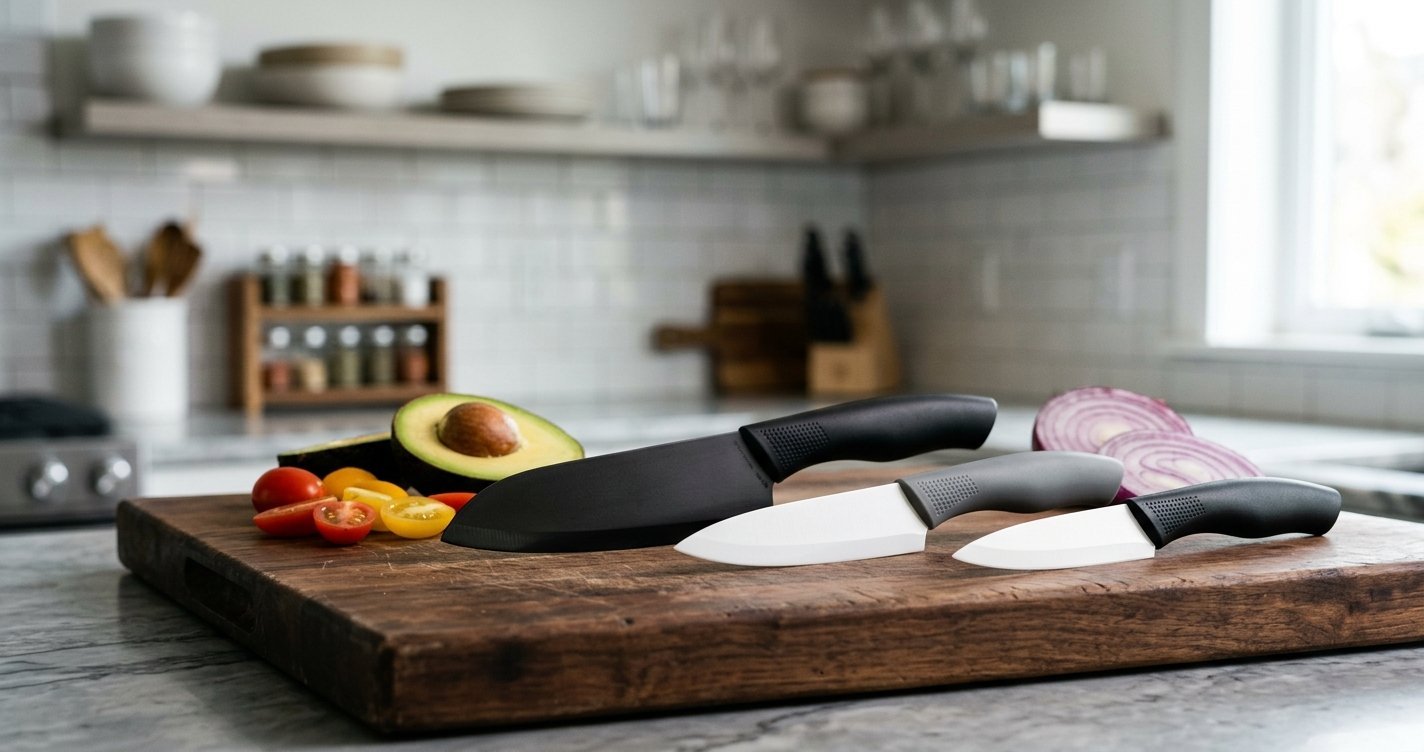
Ceramic kitchen knives are made of zirconia (zirconium oxide). They are very hard, light, rust-proof, and stay sharp much longer than steel (Fine Dining Lovers cites an estimate of up to 10 times, and Kyocera makes similar claims), but they are brittle, can chip or snap if twisted, dropped,d or used on bones or frozen food, and can only be sharpened with diamond tools. They suit precision slicing of fruit, vegetables and boneless foods, not heavy work. At Kyocera’s own site, a 3-piece Revolution set lists at $139 and a 7-inch bread knife at $90. Buy one as a specialty knife alongside a steel chef’s knife, not as your only knife.
Read More: Benchmade Knife Set Review: Contents, Price, and Verdict
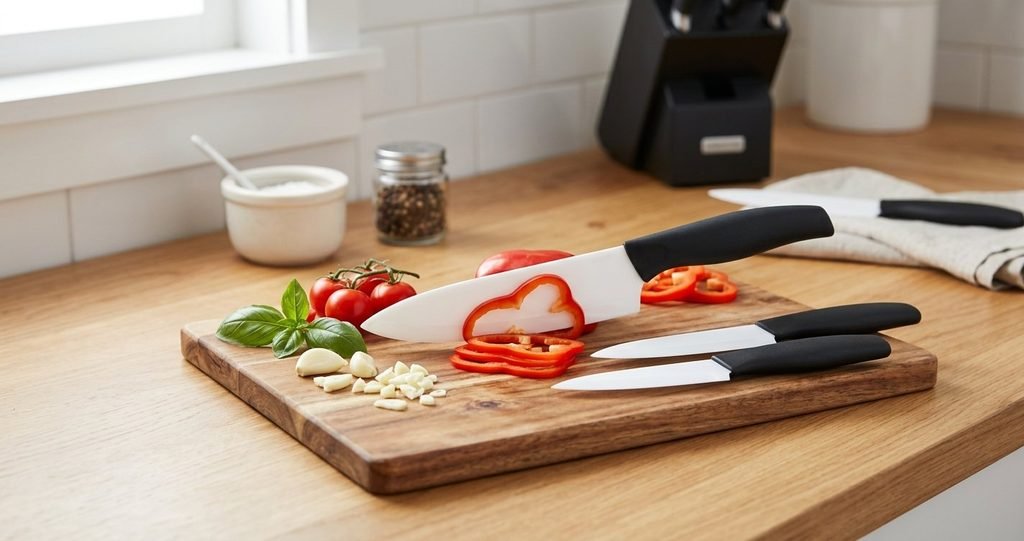
What Are Ceramic Kitchen Knives Good At?
From Fine Dining Lovers (2021), Knivesandtools and Kyocera:
| Strength | Detail |
| Edge retention | Stay sharp longer than steel in Knivesandtools’ tests; Fine Dining Lovers cites up to 10x as an estimate |
| Light weight | Kyocera says INNOVATIONwhite knives weigh about half as much as steel equivalents; Knivesandtools says many people find the low weight comfortable |
| No rust or reaction | Don’t rust, stain,n or react with acidic foods (Fine Dining Lovers); chemically inert (Kyocera) |
| Easy to clean | Non-porous (Fine Dining Lovers) |
| Delicate slicing | Tomatoes, fruit, citrus,s and sushi preparation (Fine Dining Lovers) |
What Are Their Drawbacks?
| Weakness | Detail |
| Brittleness | The main concern in Knivesandtools’ testing: small pieces broke off during testing, and Kyocera’s booklet says the knives are unsuitable for wiggling |
| Sharpening | Only diamond sharpeners work; home touch-ups with a rod or whetstone aren’t possible (Knivesandtools, Kyocera) |
| Pressure needed | Cooking For Engineers found ceramic knives needed a small downward force because their light weight doesn’t finish a cut alone |
| Staining | White blades stained from carrots in that 2011 test, st and the stains were hard to remove once dry. Kyocera says a mild baking soda solution can remove stubborn stains |
| Not repairable if large chips | Fine Dining Lovers says larger chips may not be repairable and a broken knife should be thrown away |
| Safety concern | Critics raise concern about small ceramic shards getting into food (Fine Dining Lovers) |
What the Tests Found (All Dated)
I found no current independent test of ceramic knives. The ones below are older, so treat them as background.
| Source | Date | Finding |
| Cooking For Engineers (Jordan Milford) | February 2011 | Tested Kyocera Revolution, Kyocera Damascus, Jaccard, Shenzhen, URI Eagle,gle and others against steel Calphalon and a Victorinox. The Kyocera Revolution ranked first in all four tests (carrot, potato, tomato, scallions) and was rated Outstanding; Jaccard LX was Unacceptable. The author does not think ceramic can replace steel |
| Knivesandtools | 2014 tests | Kyocera knives “delivered very sharp”; ceramic stayed sharper longer; small pieces broke off during testing; the retailer decided not to sell ceramic knives |
| Stiftung Warentest (via Kyocera’s press release) | 2014 | Kyocera FK-180WH-BK Professional Chef’s Knife rated “good” overall (2.3), the best ceramic knife in the test, per Kyocera. Kyocera’s own announcement, not the full report |
| Fine Dining Lovers | June 2021 | Summary article of pros and cons, not a test |
Caveat: the Cooking For Engineers test is 15 years old, and the author bought Kyocera’s knives because Kyocera declined to provide a sample. Reader comments reported a Kyocera Revolution chipping over three years of daily use and a chef’s knife losing its tip after a drop, which are anecdotes.
Kyocera’s Current Lineup and Prices (Manufacturer’s Site)
Kyocera is the best-known ceramic knife maker in the sources, so these prices are from its own site and may have changed.
| Product | Details | Price |
| Revolution 3-Piece Set | 6″ chef’s, 5″ micro-serrated tomato, 3″ paring | $139 |
| Revolution 2-Piece Gift Set | 5.5″ Santoku, 3″ paring | $82 |
| INNOVATION white 7″ Bread Knife | Micro-serrated, non-slip black handle | $90 |
| INNOVATION white 5-Piece Block Set | 6″, 5″, 4.5″, 3″ knives plus block | $265 |
| 4-Piece Micro-Serrated Steak Knife Set | Black/White or White | $125 |
Kyocera describes the Revolution Series as beginner-oriented and says the Revolution set claims up to 10x longer edge life than steel. That’s the maker’s marketing claim.
Price context: America’s Test Kitchen’s July 2026 winner for chef’s knives was the steel Victorinox Fibrox Pro 8-inch at $47, with the Mercer Millennia as Best Buy at usually under $30. Ceramic sets cost more than those, and ATK’s list I read did not include ceramic knives.
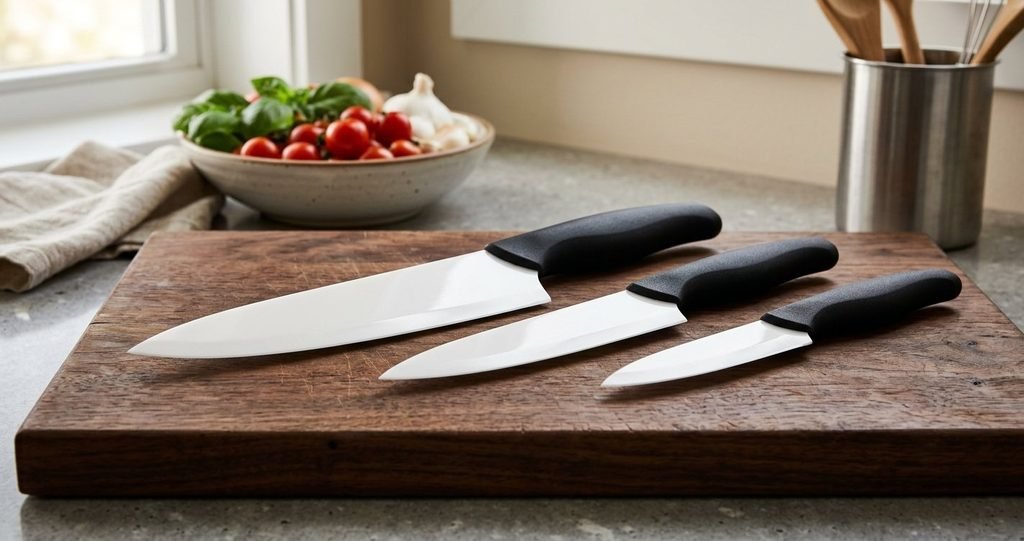
Who Should Buy Ceramic Knives?
| You… | Verdict |
| Slice fruit, vegetables, tomatoes, or boneless foods | Good fit |
| Want a light second knife and are careful | Good fit |
| Want an all-purpose or heavy-duty knife | Choose steel |
| Cut bones, frozen food, hard cheese or squash | Choose steel (Kyocera says use steel for carving, boning, frozen foods and cheese) |
| Want to sharpen at home on a whetstone | Ceramic won’t suit you |
| Have young cooks or a busy, crowded kitchen with drops | Think twice; a drop can chip or break the blade |
What to Check Before You Buy
- Buy from an authorized dealer. Kyocera’s FAQ says the one-year limited warranty applies only when bought from an authorized reseller or distributor, and products from unauthorized dealers are non-returnable.
- Check the blade length and shape. Fine Dining Lovers recommends a reputable brand, an ergonomic handle, and a blade of 7 inches or less.
- Inspect the edge. Cooking For Engineers advised inspecting a knife for nicks before buying and saw nicks at 10x magnification on some knives.
- Plan sharpening. Kyocera names EVERSHARP as its authorized resharpening provider; the page doesn’t say it’s free, so ask about price and shipping.
- Read the warranty. Kyocera’s 2021 warranty page covers defects in materials and craftsmanship, excludes accidents, misuse, normal wear, and sharpening, and says you pay shipping for returns. It doesn’t mention chipping specifically.
- Mind your board. Kyocera says to cut only on plastic or wood boards.
- Expect to keep a steel knife. Cooking For Engineers would use ceramic for certain tasks, not replace steel.
How to Care for Ceramic Knives
From Kyocera’s FAQ and Fine Dining Lovers:
- Hand wash. Kyocera recommends it; plastic-handled models can go on the top rack of a dishwasher. Fine Dining Lovers says to avoid the dishwasher.
- Cut only on plastic or wood boards, not marble, stone, plates,s or tile (Kyocera).
- Don’t twist, pry, flex,x or crush with the blade.
- Store in a knife block, not loose in a drawer (Fine Dining Lovers).
- Remove stains with a mild baking soda solution on white blades (Kyocera).
- Sharpen with diamond only, through a service or a diamond-wheel home sharpener.
- Know the dishwasher disagreement: Kyocera’s 2014 press release says the knife was rated “good” for cleaning and safe to wash in a dishwasher, while its current FAQ says hand washing is recommended. Follow the current guidance.
Ceramic vs Steel Kitchen Knives
| Ceramic | Steel | |
| Edge retention | Longer in Knivesandtools’ tests | Shorter; can be honed and resharpened at home |
| Weight | Light | Heavier |
| Rust and stains | Doesn’t rust; white blades can stain | Stainless resists rust; carbon steel rusts |
| Toughness | Brittle; can chip or snap | Tougher; Knivesandtools’ twist test: Wüsthof steel withstood 1.34 Nm vs 0.08 Nm for one Kyocera |
| Sharpening | Diamond only; service or special tool | Whetstone, rod, or service |
| Best for | Precision slicing | All-purpose |
Frequently Asked Questions
Are ceramic knives worth buying?
For precision slicing, possibly. They are brittle and need diamond sharpening, so most cooks keep a steel knife as well.
Do ceramic knives ever need sharpening?
Yes. Kyocera and Knivesandtools say only diamond tools work, and Kyocera names EVERSHARP as its authorized service.
Why do ceramic knives chip?
Zirconia is hard but brittle. Kyocera says even a knife dropped on a hard surface at the wrong angle can break, and Knivesandtools saw small pieces break off in testing.
Can ceramic knives cut meat?
Kyocera says use steel for carving, prying, and boning. Boneless slicing isn’t addressed specifically in the sources I read.
Can ceramic knives cut bread?
Kyocera sells a 7-inch micro-serrated bread knife ($90).
Can ceramic knives cut hard cheese or squash?
Kyocera says to use steel for cheese. The sources I read don’t mention squash for ceramic.
Conclusion
Ceramic kitchen knives are light, rust-proof, and hold a keen edge longer than steel, which makes them good for precise slicing of fruit, vegetables, and boneless foods. They are also brittle, can only be sharpened with diamond tools, and chip or break if twisted, dropped,d or used on bones or frozen food. Kyocera’s sets range from $82 to $265, and the independent tests I found are from 2011 and 2014. Buy ceramic as a careful, specialty second knife from an authorized dealer, and keep a steel chef’s knife for everything else.
1 thought on “Ceramic Kitchen Knives: Pros, Cons, and What to Look For”