
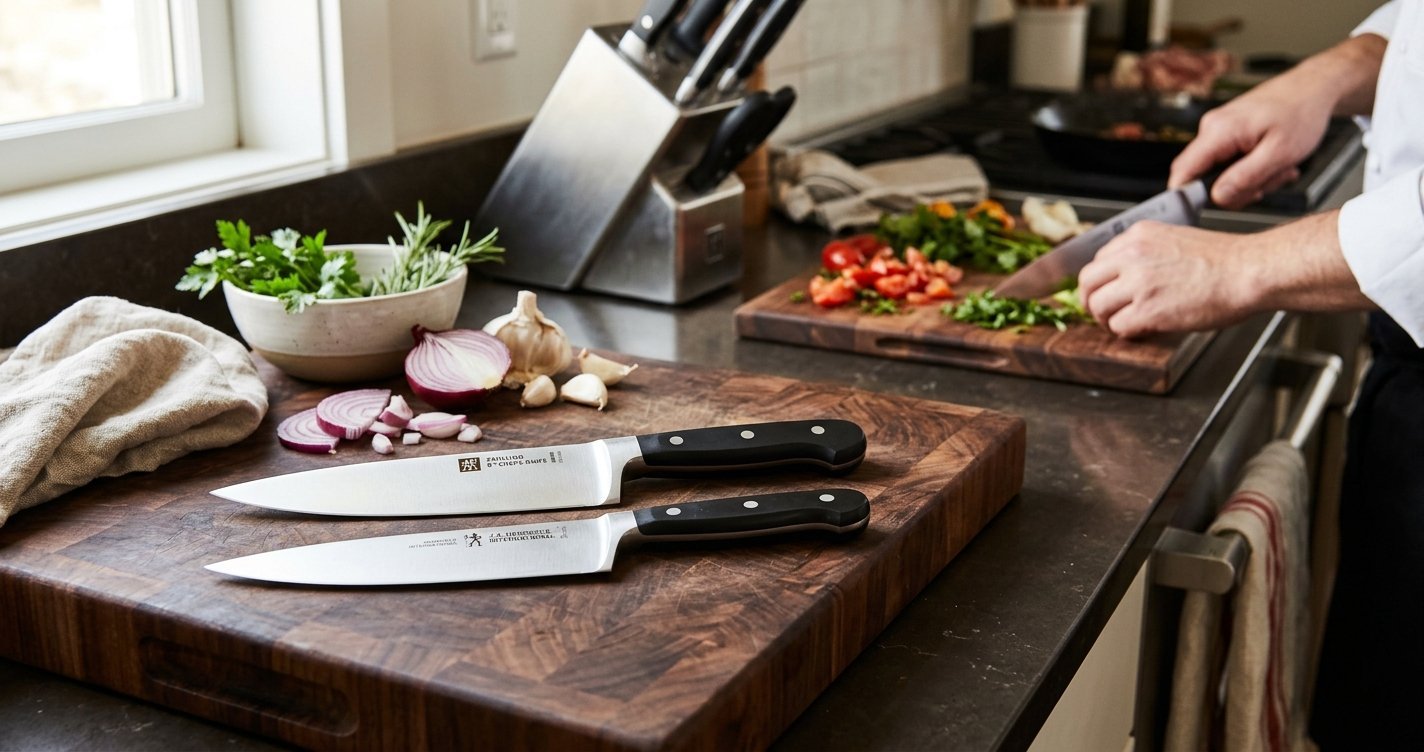

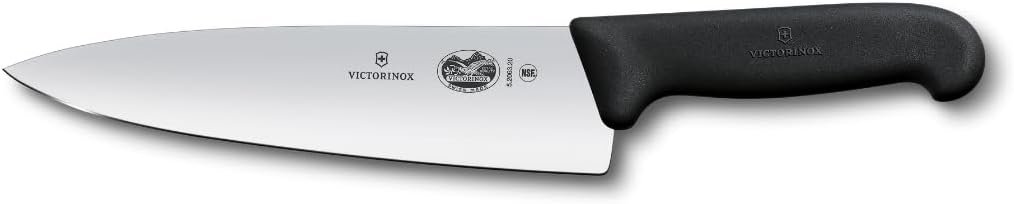
Choosing between the Victorinox Fibrox and Wusthof chef’s knives can be challenging, especially when both brands are known for producing reliable kitchen knives. Whether you are a home cook upgrading your kitchen or a professional chef looking for a dependable cutting tool, the right knife can make food preparation easier, faster, and more comfortable.
The Victorinox Fibrox vs Wusthof chef’s knife comparison comes down to three main factors: budget, cutting performance, and long-term value. Victorinox is widely recognized for offering practical, affordable knives with comfortable, slip-resistant handles. Wusthof, a German knife manufacturer, is known for its premium construction, refined finish, and extensive range of chef’s knives.
In this guide, we compare both options across essential features, pricing, sharpness, durability, ergonomics, and maintenance. We will also explain which knife offers the best value for different types of cooks and what to consider before purchasing.
Read More: Are Henckels Knives of Good Quality? Honest Buyer Guide
Victorinox Fibrox vs Wusthof Chef’s Knife: Quick Comparison
| Feature | Victorinox Fibrox | Wusthof Chef’s Knife |
| Brand origin | Switzerland | Germany |
| Typical price category | Budget-friendly | Mid-range to premium |
| Blade material | Stainless steel | German stainless steel |
| Handle material | Fibrox thermoplastic elastomer | Varies by model |
| Handle design | Textured, slip-resistant | Varies by collection |
| Cutting performance | Excellent for everyday prep | Excellent, depending on model |
| Weight | Generally lightweight | Varies; many models feel heavier |
| Maintenance | Relatively easy | Relatively easy |
| Best for | Budget-conscious cooks and busy kitchens | Cooks seeking premium fit and finish |
| Overall value | Excellent performance for the price | Strong investment for frequent use |
Quick verdict: Choose the Victorinox Fibrox if you want a capable chef’s knife without spending much. Choose Wusthof if you prefer a more premium knife and are willing to pay more for its construction, feel, and finish.
Keep in mind that Wusthof sells several knife collections, including different blade constructions and handle designs. Comparisons are most meaningful when you match knives of similar sizes and intended uses.
1. Price and Value for Money
Price is one of the biggest differences between Victorinox Fibrox and Wusthof chef’s knives.
Victorinox Fibrox is designed to deliver dependable performance at an accessible price. It is particularly attractive to beginner cooks, students, budget-conscious households, and professional kitchens that need practical knives for frequent use.
Wusthof generally occupies a higher price bracket. Depending on the collection, its knives may feature more refined finishing, different handle materials, and a more substantial overall feel. You are paying for more than basic cutting ability, although a higher price does not automatically mean better results for every cook.
| Buying consideration | Victorinox Fibrox | Wusthof |
| Initial investment | Lower | Usually higher |
| Everyday performance | Excellent | Excellent |
| Value for beginners | Excellent | Good, but often unnecessary |
| Premium appearance | Functional design | More options for refined finishes |
| Value for frequent cooking | Very strong | Strong if you appreciate its features |
Which offers better value?
For most shoppers who prioritize performance per dollar, Victorinox Fibrox is the stronger choice. Wusthof may be worth the additional expense if its balance, finish, handle design, or particular blade construction suits your preferences.
Writing
2. Blade Quality and Construction
Blade construction is a major difference between the Victorinox Fibrox and Wusthof Classic chef’s knife.
The Victorinox Fibrox chef’s knife uses a stamped blade, meaning the blade is cut from a sheet of steel and then shaped and finished. This manufacturing method helps keep the knife lightweight and affordable without sacrificing everyday usefulness.
The Wusthof Classic chef’s knife features a forged blade made from a single piece of steel. Forging, together with its full bolster and full-tang construction, gives the knife a more substantial feel and a traditional premium design.
| Blade feature | Victorinox Fibrox | Wusthof Classic |
| Manufacturing method | Stamped | Forged |
| Blade steel | Stainless steel | German stainless steel |
| Full bolster | No | Yes |
| Full tang | Model-dependent construction details | Yes |
| Weight and feel | Lightweight | Heavier and more substantial |
| Best advantage | Easy handling and affordability | Traditional construction and balance |
Wusthof’s official product information lists the Classic series at approximately 58 HRC on the Rockwell hardness scale. Victorinox Fibrox blades are generally softer, although exact specifications depend on the model.
A harder blade can help retain its edge for longer under comparable conditions, but it may require a different sharpening approach. Steel hardness alone does not determine cutting performance.
Winner: Wusthof Classic for traditional forged construction; Victorinox Fibrox for a lighter, more economical design.
3. Sharpness and Cutting Performance
A chef’s knife needs to cut cleanly through vegetables, meat, herbs, and other ingredients without excessive force.
Both Victorinox Fibrox and Wusthof knives can deliver excellent cutting performance when properly sharpened. The difference lies in their blade geometry, factory edge, weight, and how each knife feels during use.
The Victorinox Fibrox offers an effective edge for routine kitchen preparation. Its lighter design makes it easy to maneuver when chopping onions, slicing tomatoes, dicing peppers, and mincing herbs.
The Wusthof Classic offers a more substantial blade and a refined cutting feel. Depending on the exact model and sharpening condition, it may provide a particularly satisfying experience for cooks who prefer a heavier knife with a traditional rocking motion.
| Cutting task | Victorinox Fibrox | Wusthof Classic |
| Chopping vegetables | Excellent | Excellent |
| Slicing tomatoes | Excellent when sharp | Excellent when sharp |
| Mincing herbs | Very good | Very good |
| Cutting boneless meat | Excellent | Excellent |
| Repetitive meal preparation | Lightweight and nimble | Stable and substantial |
| Rock-chopping technique | Good | Good to excellent, depending on preference |
Neither knife automatically wins every cutting test. A sharp Victorinox can outperform a poorly maintained Wusthof, while a properly sharpened Wusthof may feel more controlled to someone who prefers its weight and blade geometry.
Winner: A close comparison. Choose based on blade feel and maintenance preferences rather than brand reputation alone.
4. Handle Comfort and Ergonomics
Handle comfort matters because a chef’s knife is often used for extended periods. A poorly fitting handle can cause fatigue, reduce control, and make repetitive chopping less enjoyable.
Victorinox Fibrox is especially well known for its textured, non-slip handle. The design prioritizes grip and practicality, making it appealing to cooks who prepare large quantities of food or frequently handle ingredients with damp hands.
Wusthof offers several handle designs across its collections. The Classic series uses a traditional riveted synthetic handle, while other collections have different shapes and finishes. Its heavier construction may feel reassuring to some users but tiring to others.
| Ergonomic factor | Victorinox Fibrox | Wusthof Classic |
| Handle grip | Textured and slip-resistant | Smooth synthetic handle |
| Overall feel | Lightweight and practical | Heavier and substantial |
| Extended chopping | Low-fatigue feel for many users | Comfortable if you prefer more weight |
| Traditional appearance | Functional | Classic premium styling |
| Best for | Practical everyday handling | Cooks who like a substantial knife |
Winner: Victorinox Fibrox for a practical, textured grip. Wusthof may be preferable if its handle shape and weight fit your hand better.
Whenever possible, hold both knives before buying. Hand size, grip style, and cutting technique can influence comfort more than brand alone.
5. Durability and Edge Retention
Durability involves more than whether a knife breaks or bends. It also includes resistance to corrosion, the ability to withstand repeated use, handle longevity, and how easily the blade can be restored when dull.
Victorinox Fibrox is built for regular kitchen work. Its stainless steel blade and practical handle make it a dependable option for everyday cooking and demanding food-preparation environments.
Wusthof Classic combines forged construction with a harder blade than typical Fibrox models. This can help the edge stay sharp longer under comparable conditions, although the actual difference depends on cutting technique, ingredients, board material, and sharpening practices.
| Durability factor | Victorinox Fibrox | Wusthof Classic |
| Everyday reliability | Excellent | Excellent |
| Edge retention | Good | Generally better under comparable conditions |
| Ease of sharpening | Generally easy | Also straightforward with suitable tools |
| Corrosion resistance | Good with proper care | Good with proper care |
| Long-term ownership | Excellent value | Premium long-term option |
One important consideration is that neither knife is indestructible. Avoid cutting through bones, twisting the blade in hard ingredients, or using the knife on glass, stone, or other hard surfaces.
For longevity, use a suitable cutting board, clean and dry the knife after use, and sharpen it when necessary.
Winner: Wusthof Classic for potential edge retention; both are durable choices when properly maintained.
6. Maintenance and Sharpening
A knife’s maintenance requirements affect its long-term cost and usability.
Victorinox Fibrox is generally easy to sharpen, making it a practical choice for people who maintain their own kitchen knives. Its softer blade can be restored relatively quickly with suitable sharpening equipment.
Wusthof Classic also responds well to proper sharpening, but its harder steel may take a little more work to restore, depending on the sharpening method and the condition of the edge.
| Maintenance task | Victorinox Fibrox | Wusthof Classic |
| Regular cleaning | Easy | Easy |
| Honing between sharpenings | Recommended as needed | Recommended as needed |
| Sharpening at home | Beginner-friendly | Beginner-friendly with practice |
| Dishwasher use | Check the specific model; hand-washing is preferable | Hand-washing recommended |
| Storage | Knife block, sheath, or magnetic strip | Knife block, sheath, or magnetic strip |
Although Victorinox identifies certain Fibrox models as dishwasher-safe, hand-washing and immediate drying are better habits for preserving a knife’s edge and finish. Wusthof recommends hand-washing its knives.
For either brand, a suitable whetstone or sharpening service can help maintain performance. A honing rod may help realign the edge between sharpening sessions, but it does not replace sharpening when the blade becomes dull.
Winner: Victorinox Fibrox for straightforward, economical maintenance, although both knives are manageable for home cooks.
7. Which Knife Should You Buy?
The best choice depends on your budget, cooking frequency, and preferred knife feel.
Choose Victorinox Fibrox if:
- You want an affordable chef’s knife with excellent everyday performance.
- You prefer a lightweight blade for quick chopping and slicing.
- You value a textured, slip-resistant handle.
- You are a beginner building your first quality kitchen setup.
- You want to spend less upfront without sacrificing practical cutting ability.
Choose Wusthof Classic if:
- You prefer a traditional forged chef’s knife.
- You enjoy a heavier blade with a substantial feel.
- You value refined finishing and premium construction.
- You want a knife with good edge retention and are comfortable maintaining it.
- You are willing to pay more for a knife that suits your personal preferences.
Best choice by buyer type
| Buyer type | Recommended knife | Why |
| Beginner home cook | Victorinox Fibrox | Affordable and versatile |
| Budget-conscious shopper | Victorinox Fibrox | Strong performance for the price |
| Busy household | Victorinox Fibrox | Lightweight and practical |
| Professional cook | Either | Depends on workflow and preference |
| Premium knife enthusiast | Wusthof Classic | Forged construction and refined finish |
| Cook who prefers heavier knives | Wusthof Classic | More substantial feel |
| Shopper prioritizing edge retention | Wusthof Classic | Generally offers an advantage under comparable conditions |
8. Where to Buy Victorinox Fibrox and Wusthof Chef’s Knives
Both brands are available through their official websites and authorized kitchenware retailers. Before purchasing, compare the exact model, blade length, handle design, warranty, shipping charges, and return policy.
Here are useful starting points:
- Victorinox Fibrox: Browse the official Victorinox chef’s knife range.
- Wusthof Classic: Explore the official WÜSTHOF knife collections.
The Victorinox Fibrox 20 cm chef’s knife is a useful starting point for value-focused shoppers. For a premium comparison, look at the Wusthof Classic 8-inch chef’s knife.
Prices vary by country, retailer, and collection. Check current listings rather than relying on a fixed price quoted in an older review.
When comparing online offers, prioritize reputable sellers and verify the model number to avoid confusing the Wusthof Classic with less expensive collections such as Wusthof Gourmet.
Frequently Asked Questions
1. Is Victorinox Fibrox better than Wusthof?
Victorinox Fibrox is better for shoppers who prioritize affordability, lightweight handling, and value for money. Wusthof Classic is better suited to buyers who prefer forged construction, a heavier feel, and potentially longer edge retention. Neither is universally better.
2. Why is Wusthof more expensive than Victorinox Fibrox?
Wusthof Classic uses forged construction, a full bolster, and premium finishing. These features contribute to its higher price. Victorinox Fibrox uses a more economical stamped construction that delivers excellent everyday performance at a lower cost.
3. Which knife stays sharp longer?
Wusthof Classic generally has an edge-retention advantage over Victorinox Fibrox because of its harder blade and edge geometry. However, sharpening quality, cutting technique, and maintenance significantly affect how long either knife performs well.
4. Is Victorinox Fibrox good enough for professional chefs?
Yes. Victorinox Fibrox is a practical option for professional kitchens because it offers reliable cutting performance, a comfortable non-slip handle, and an accessible replacement cost. Some chefs prefer heavier or more premium knives, but a higher price is not essential for professional results.
5. Is Wusthof worth the extra money?
Wusthof Classic can be worth the additional cost if you appreciate its weight, forged construction, handle design, and edge retention. If you primarily want a dependable knife for routine meal preparation, Victorinox Fibrox may provide better value.
6. Which knife is easier to sharpen?
Victorinox Fibrox is generally easier to sharpen because its blade is relatively soft. Wusthof Classic can also be sharpened effectively at home, but restoring its edge may require more effort depending on the tools and sharpening technique.
7. Which knife is better for beginners?
Victorinox Fibrox is usually the better starting point because it is affordable, lightweight, versatile, and relatively easy to maintain. Beginners can invest the money saved in a suitable cutting board and sharpening equipment.
8. Are Victorinox Fibrox and Wusthof made in the same country?
No. Victorinox Fibrox chef’s knives are Swiss-made, while Wusthof Classic knives are manufactured in Solingen, Germany.
9. Which knife should I buy: 8-inch or 10-inch?
An 8-inch chef’s knife is a versatile choice for most home kitchens. A 10-inch knife offers a longer cutting edge for larger ingredients and longer slicing strokes, but it may feel less manageable to users with smaller hands or limited counter space.
For most first-time buyers, an 8-inch model from either brand is a sensible starting point.
Conclusion
The Victorinox Fibrox vs Wusthof chef’s knife comparison reveals two excellent options for different budgets and cooking preferences.
Victorinox Fibrox is the better overall value for most home cooks. Its affordable price, lightweight construction, comfortable non-slip handle, and reliable cutting performance make it a practical everyday kitchen tool.
Wusthof Classic is the stronger choice for buyers who prefer a traditional forged knife with a substantial feel, premium finishing, and generally better edge retention. Its higher price makes the most sense when these features matter to you.
Our recommendation: Buy the Victorinox Fibrox if you want the best balance of performance and price. Choose the Wusthof Classic if you value premium construction and prefer a heavier chef’s knife.