
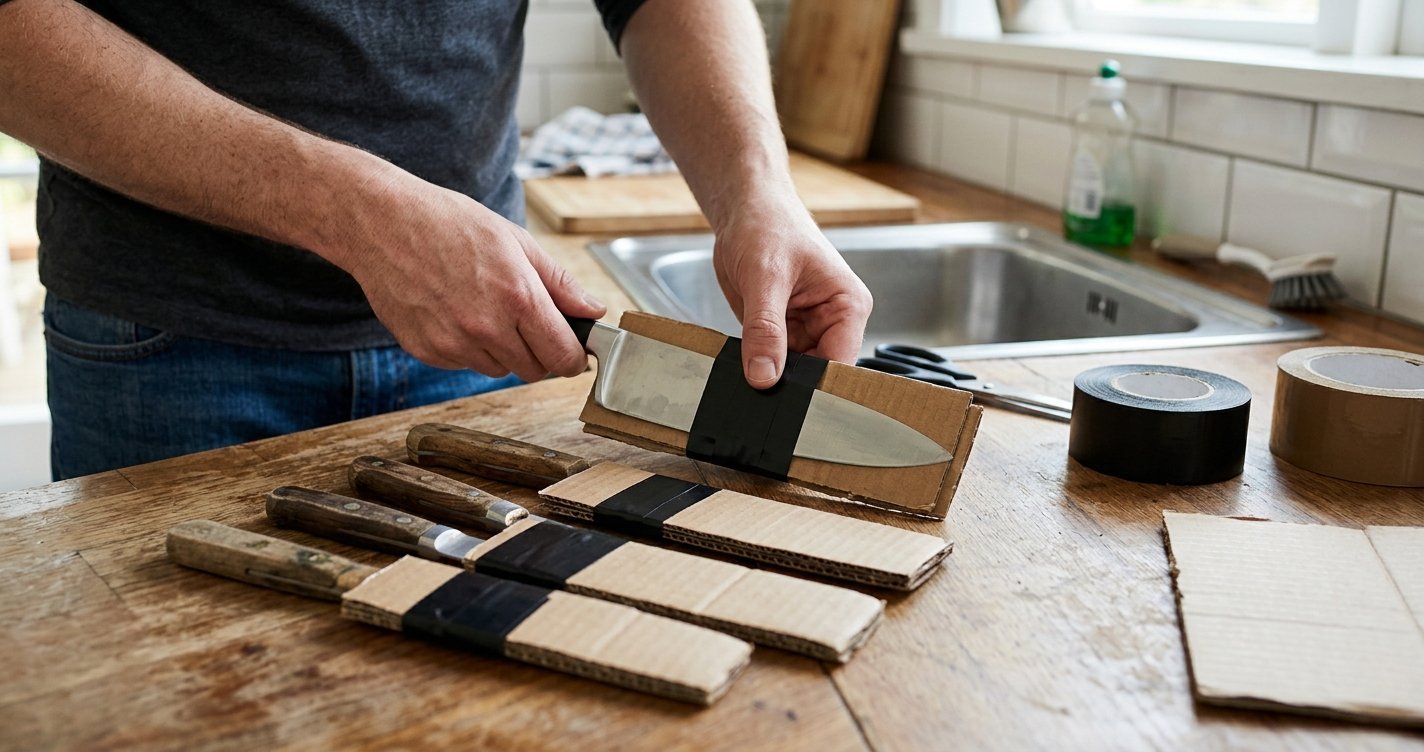
Never toss a knife loose into the trash or the curbside recycling bin. Wrap each blade in several layers of newspaper or cardboard, tape it, and put it in a sturdy sealed box. Then pick the route that fits: donate it if it’s still in good condition, take it to a scrap metal recycler or recycling center if your area has one, or put the wrapped, boxed knife in the trash if it’s too damaged and no recycler is nearby. Rules vary by location, so check with your local waste department first.
Read More: Buck Kitchen Knife Set: Models, Prices & Verdict
Which Option Is Right for Your Knife?
| Knife condition | Best option | Why |
| Still sharp or easily sharpened | Donate or give away | Another person can use it |
| Worn, rusty, or damaged, but you have a scrap metal recycler nearby | Scrap metal recycling | Keeps the metal out of the landfill |
| Too damaged to use, and no recycler nearby | Wrapped and boxed trash | Bob Vila says to use the trash only in this case |
This table is my summary of the sources below. Bob Vila’s article presents donation, recycling, and trash in that order.
Step 1: Clean the Knife
Tasting Table says to scrub the knife first to avoid pest problems, and to clean it more thoroughly if you’re donating it. Hunker adds that donated knives should be washed in warm, soapy water, dried, and sharpened if possible.
Step 2: Wrap and Box It Safely
All the US-focused guides give a similar process. This version combines Bob Vila, Reviewed, and Tasting Table:
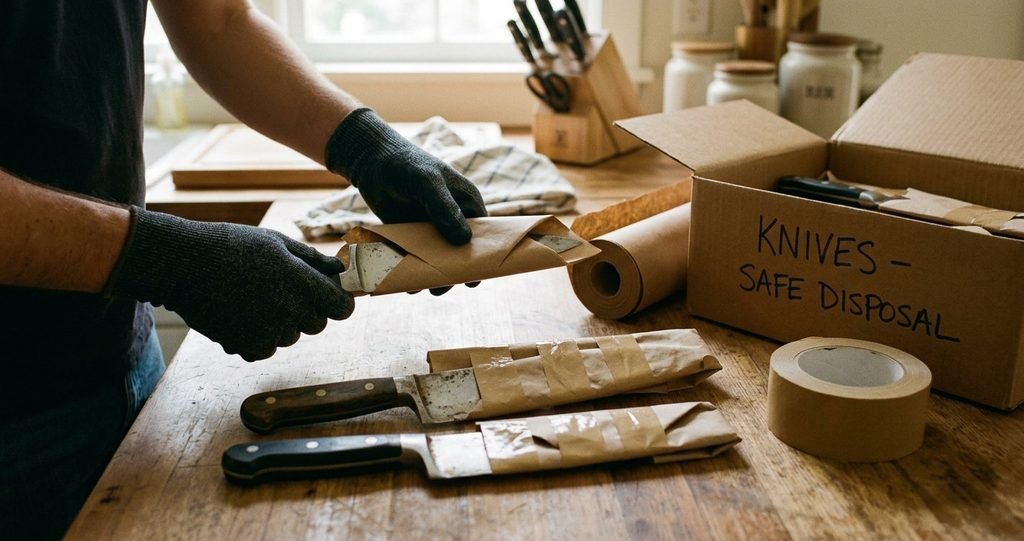
- Wrap each blade separately in several layers of newspaper or other large paper, and tape it in place.
- Cut a flat piece of cardboard at least twice as long as your longest blade (Bob Vila). Fold it over the wrapped knives and tape it so they can’t shift.
- Place the bundle in a sturdy box and seal it with tape.
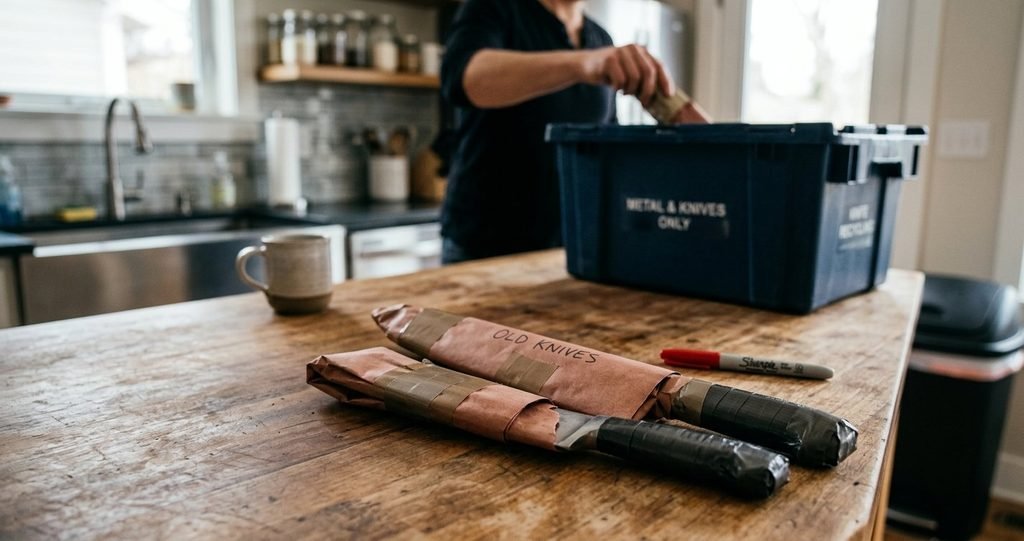
- Label the box so sanitation workers know what’s inside. Tasting Table says to mark what’s inside, and Hunker suggests “Caution: Sharp.”
Why it matters:
- Loose knives can cut through trash bags or injure someone reaching into the trash (Reviewed).
- Bob Vila says not to put knives loose in a plastic bag, because blades can cut through it.
- Hunker lists a puncture-proof container with a tight lid, such as a coffee can or a plastic milk or bleach jug, as an alternative to a box, and says not to use glass containers, which can break and create a new hazard.
Option 1: Donate or Give Away
Good for knives that still work.
- Where: local shelters, soup kitchens, thrift and secondhand stores (Reviewed), or a friend or someone who could restore and sharpen them (Bob Vila).
- Call first. Reviewed notes that some donation centers, including Goodwill and the Salvation Army, don’t accept knives, and some will pick up donations. Tasting Table also says to call the charity or donation center first.
- Prepare them. Clean, wrap, and box the knives, and label the box (for example, “Sharp Kitchen Knives,” per Hunker).
- Tax receipt. Reviewed,d and Hunker both say you can ask for a receipt or value estimate. I haven’t verified the tax rules, so ask a tax professional if it matters to you.
Option 2: Scrap Metal Recycling
Good for worn-out knives, if you have somewhere to take them.
- Not curbside. Reviewed and Bob Vila both say knives don’t go in the curbside recycling bin. Hunker adds that those bins are meant for items like aluminum cans.
- Where to take them: a scrap metal recycler, transfer station, or town dump that accepts scrap metal (Reviewed, Bob Vila). Search online for “knife recycling near me” or check your city, county, or state website.
- If you can’t find one, Hunker says to contact your state’s environmental protection or quality agency.
- Pack them first with the wrap-and-box steps above.
UK examples: two UK councils I checked, Staffordshire and Dundee, both say knives can go into the scrap metal container at a household recycling centre, or in the general waste bin if the blade is wrapped first.
Option 3: Throw It Away (Last Resort)
- Use the trash only if the knife is too damaged to use and no scrap metal center is nearby (Bob Vila).
- Follow the wrapping and boxing steps above.
- Staffordshire council says kitchen knives can go in the general waste bin if the blade is wrapped in newspaper or card. Dundee asks for cardboard, bubble wrap, or similar.
I couldn’t find a US city page that spells out the rule for knives. For example, Miami-Dade’s recycling A to Z has no entry for knives and tells residents to email its solid waste department, with Earth911 as a place to search. Your local waste department is the authority.
What About Carbon Steel and Hazardous Waste?
Tasting Table says stainless steel knives are fine in the trash, but that carbon steel blades may be hazardous waste because they can give off harmful fumes. I couldn’t confirm this elsewhere, and the other sources don’t mention it. If you have carbon steel knives, call your local sanitation department to confirm what it accepts.
Other Things to Know
- Check local rules first. Tasting Table says to check whether your area allows disposing of knives and whether your local recycling center accepts metal knives. Some municipalities run scrap metal programs that include old knives.
- Consider resharpening instead. Tasting Table lists signs a knife needs replacing: dullness, chips, bends, dents, rust, loose rivets,s and broken handles. An only dull knife may not need to go. I found no source covering sharpening services in detail.
- Magnets at sorting plants. Hunker says plants use magnets to pull out steel and iron, so stainless knives can be sorted this way, and warns that magnets don’t detect aluminum. I haven’t verified how this applies to every plant.
- Keep them away from children and anyone who may handle the bin. Hunker mentions children and sanitation workers.
Frequently Asked Questions
Can I put kitchen knives in the trash?
Yes, in many places, but not loose. Wrap the blade in paper and cardboard, tape it, put it in a sturdy box, and label it. Check your local rules.
Can I put kitchen knives in the recycling bin?
No. Reviewed, Bob Vi, la and Hunker say knives don’t belong in curbside recycling.
Where can I recycle old knives?
A scrap metal recycler, transfer station,n or town dump that accepts scrap metal, per Reviewed and Bob Vila. Search online or check your local government’s website.
How do I wrap a knife for disposal?
Wrap the blade in several layers of newspaper, tape it, fold a piece of cardboard over it, tape that, and put it in a sealed box.
Do I need to label the box?
Tasting Table says to mark what’s inside so sanitation workers can handle it carefully. Hunker suggests “Caution: Sharp.”
Who do I ask about local rules?
Your city or county solid waste department. If you can’t find a recycler, Hunker suggests your state environmental agency.
How do I know when to replace a knife?
Tasting Table lists dullness, chips, bends, dents, rust, loose rivets, and broken handles.
Conclusion
To dispose of kitchen knives safely, clean them, wrap each blade in layers of paper and cardboard, tape it, and seal it in a labeled box. Donate knives that still work, take worn-out ones to a scrap metal recycler if one is nearby, and use the trash only as a last resort. Never put knives loose in a bag or in the curbside recycling bin. Because local rules differ and the sources disagree on carbon steel, a quick call to your local waste department is worth making before you decide.
1 thought on “How to Dispose of Kitchen Knives Safely: 4 Options”