
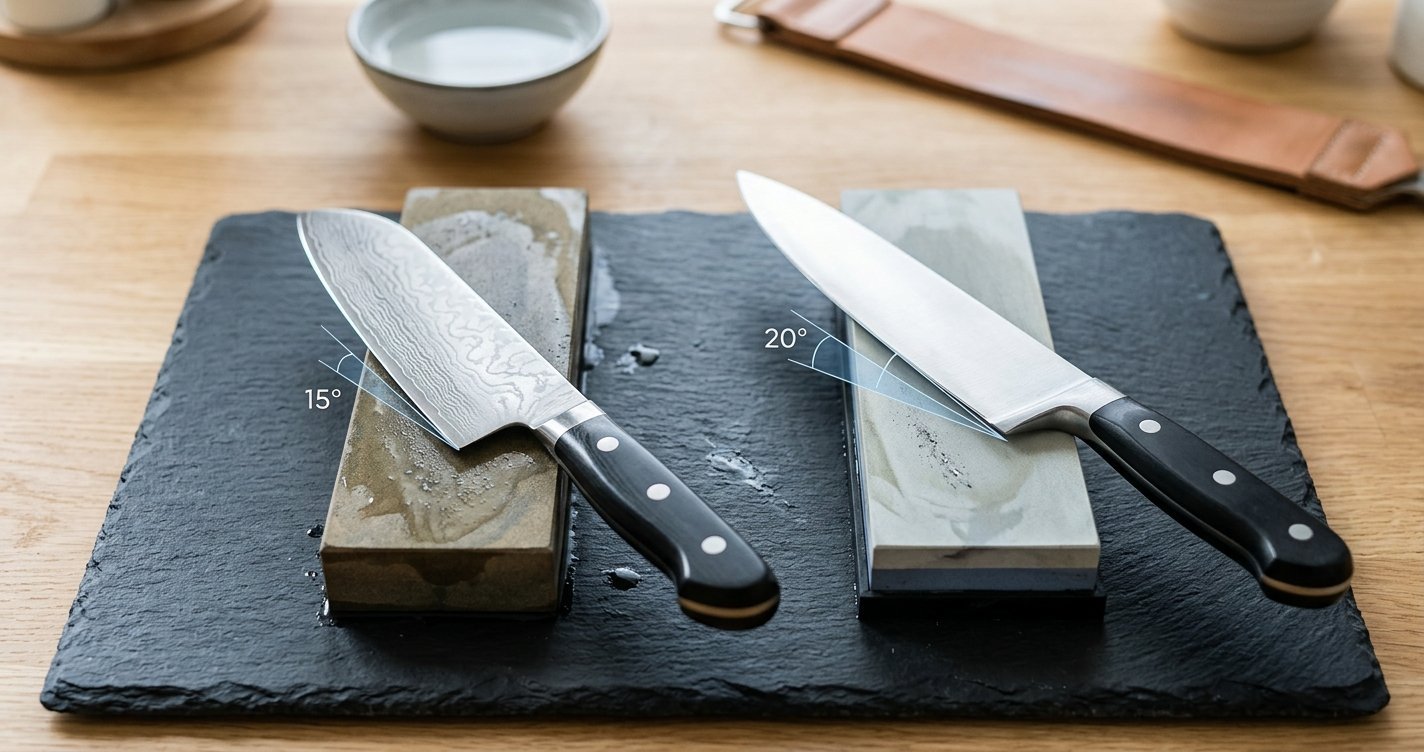
Sharpen to the angle your knife was made with. As a starting point, that’s about 15° per side for Japanese-style knives (some use 10°) and roughly 14° to 20° per side for Western knives, depending on the brand. America’s Test Kitchen says Western knives traditionally had 20° edges, but many manufacturers now sell 15° blades, so check with the maker. Holding the angle consistently matters more than hitting a number exactly.
Read More: How to Dispose of Kitchen Knives Safely: 4 Options
Angles by Knife Type
| Knife type | Typical angle per side | Source |
| Traditional Western (German, American) | About 20° (up to 22°) | ATK, zknives |
| Modern Western knives | 14° to 15° (for example Wüsthof PEtec at 14.5°, and ATK’s top three tested knives at 15°) | Wüsthof, ATK |
| Asian-style or Japanese double-bevel (gyuto, santoku) | 10° to 15° | Hasu-Seizo, zknives |
| Wüsthof’s guidance for Asian-style knives | 10° | Wüsthof |
Per side or total? The angles above are per side unless noted. Total (“included”) angle is double: a 20° per-side edge is about 40° overall. zknives says Western edges are about 20° to 22° per side, or over 40° included. ATK’s angle article doesn’t say which it means, so I treat its figures as per side, which matches the 15° and 20° coin method in its whetstone guide. That is my reading.
Sources: America’s Test Kitchen, Wüsthof’s PEtec page, Wüsthof’s sharpening guide, zknives (last updated 2019), and Hasu-Seizo (a knife seller, so its advice has a commercial interest).
Why the Angle Matters
- Smaller angle, sharper but more delicate. ATK says that, assuming similar sharpness, a thinner edge slides through food more easily. Hasu-Seizo says a lower angle gives a sharper edge but can chip or dull more easily. zknives agrees that thin edges need hard steel and careful use.
- Larger angle, tougher. zknives says manufacturers use thick edges partly to reduce returns from users who abuse their knives.
- Steel matters. ATK’s Cook’s Illustrated article says Western knives use softer steel, which can’t hold a narrower edge for long, while Japanese knives use harder, more brittle steel that holds a narrow edge longer.
What this means: the “best” angle depends on the steel and how you use the knife, not on one fixed number.
How to Find Your Knife’s Angle
- Ask the manufacturer. ATK says you can’t reliably tell a blade’s angle by looking, and suggests contacting the maker.
- Check the brand’s guidance. For example, Wüsthof says to tilt the knife to 14° against a honing steel and 10° for an Asian-style knife, and its PEtec knives have a 14.5° edge per side.
- If you can’t find it, use the type-based defaults in the table: about 15° for Japanese-style and 20° for traditional Western blades.
I found no manufacturer-published angle for Victorinox, so I can’t give one. The only Victorinox angle I can cite is that ATK’s winning Victorinox Fibrox Pro was among its tested 15° blades.
How to Hold the Angle
ATK’s whetstone guide gives these ways to find and hold the angle:
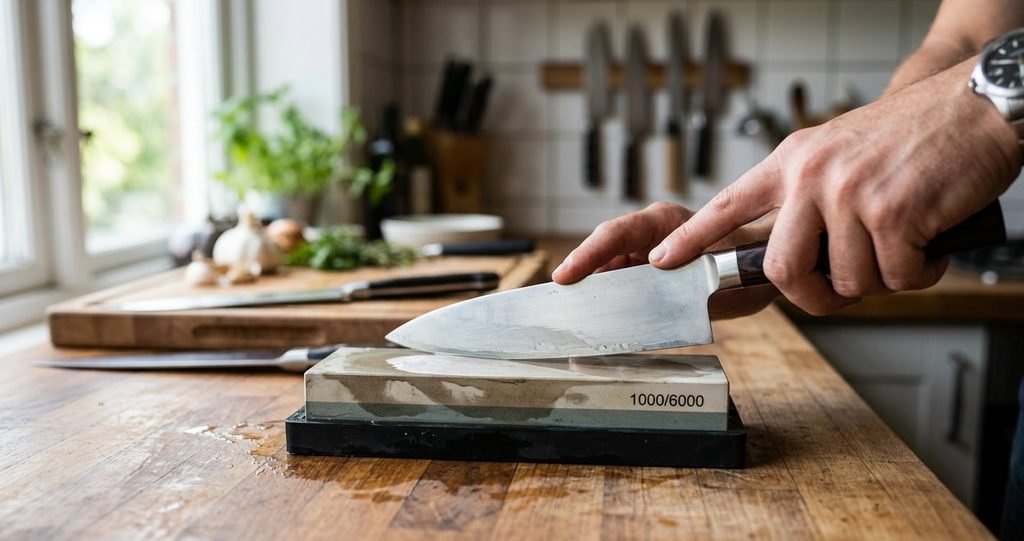
- The halving method: hold the blade at 90° to the stone, halve it to 45°, halve again to about 22.5°, then lower it slightly toward your blade’s angle.
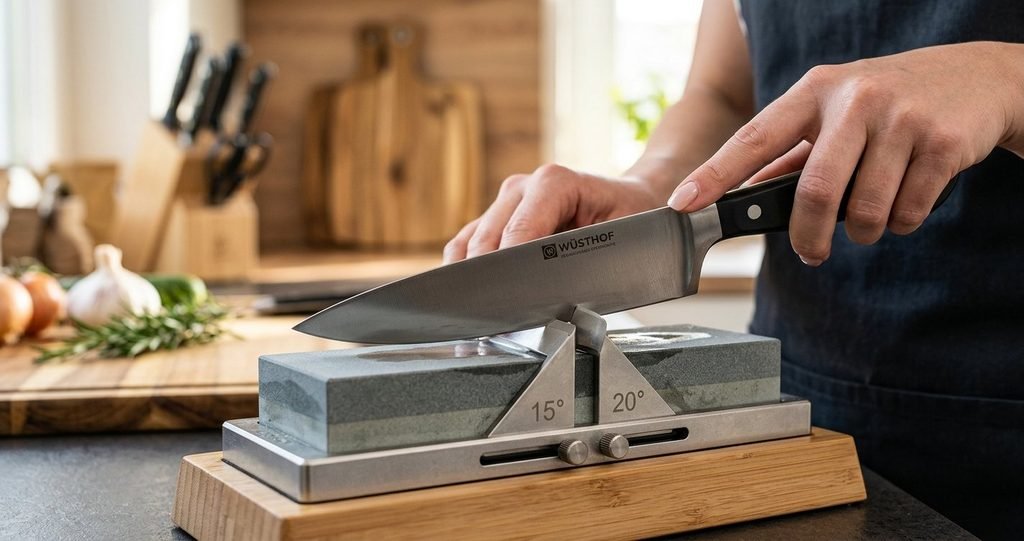
- The coin method: tape two stacked nickels under the spine for roughly 20°, or two dimes for roughly 15°. Commercial blade guides are also sold.
From Sharpening Supplies (a retailer, so it also promotes its own products):
- Grip: rest your thumb on top of the blade near the edge and your index finger along the spine to keep it from twisting.
- Lock your wrist so the blade doesn’t tilt.
- Move your body, not your arms, with large, steady strokes.
- Work in sections on long or curved blades.
- Lift the handle slightly near the tip so the tip stays on the stone without changing the angle.
Marker test: color the bevel with a marker, make a few passes, and see where the ink comes off. Ink removed only at the edge means the angle is too low, and ink removed along the top of the bevel means it’s too high (Sharpening Supplies).
Step-by-Step: Sharpening on a Whetstone
Based on ATK’s whetstone guide:
- Set up. Place the stone on a damp towel or rubberized liner, coarse side up. ATK says whetstones need no lubricant.
- Set the angle, about 15° for Asian-style knives or 20° for Western-style (or your knife’s own angle).
- Draw the blade across the stone in a wide arc, from handle to tip, keeping the angle constant and your fingers flat and away from the edge.
- Check every 10 passes. Run your thumb across the edge, never along it. When you can feel a burr from handle to tip, that side is sharp enough.
- Flip and repeat on the other side.
- Move to the fine side and repeat to finish.
ATK doesn’t specify how much pressure to apply. Sharpening Supplies adds that you should start with a coarse grit, not a fine one, because coarse grits remove material faster with fewer passes
Honing vs Sharpening
Wüsthof’s guide separates the two: honing is regular maintenance, while sharpening creates a new edge when the knife needs a reset. It says to use the coarse slot of its hand-held sharpener only once or twice a year, and doesn’t give a honing interval. Hand-held and electric sharpeners use preset angles, so you don’t set one yourself.
Should You Change Your Knife’s Angle?
Some people re-angle German knives to 15°. The sources are split:
- zknives says the author sharpened Wüsthof and Henckels knives to 15° per side without problems, with cutting performance improved several times over and only a modest drop in edge retention. If 15° feels too fragile, he suggests adding a secondary 20° bevel. That’s one author’s experience.
- ATK (Cook’s Illustrated) tested shaving a favorite inexpensive Western knife from 20° to 15° with an electric sharpener. The knife felt better, with less drag and more precision, but the authors caution against it. Softer Western steel can’t hold the narrower edge for long, and re-angling removes a noticeable amount of metal. They concluded that if you want a 15° feel, buying a Japanese knife is better than altering a Western one. That page carries a members-only label, though the text I could read appeared complete.
What this means: if you want a thinner edge, a knife already made at that angle may be the safer route.
Common Mistakes
- Moving your wrist, which changes the angle (Sharpening Supplies).
- Rushing, especially as a beginner (Sharpening Supplies).
- Starting with a fine grit (Sharpening Supplies).
- Guessing the angle by eye. ATK says you can’t reliably tell a blade’s angle by looking.
- Using the wrong angle for the steel. A very thin angle on soft steel can dull sooner, per ATK.
Frequently Asked Questions
What is the best angle to sharpen a kitchen knife?
There’s no single best angle. Use the angle your knife was made with, or about 15° per side for Japanese-style and 20° per side for traditional Western knives.
What angle should I sharpen a chef’s knife?
It depends on the brand. Wüsthof’s PEtec knives are 14.5° per side, and ATK’s top three tested chef’s knives were 15°. Traditional Western knives were 20°.
What angle should I sharpen a Japanese knife?
10° to 15° per side for double-bevel knives such as a gyuto or santoku, per Hasu-Seizo. Wüsthof suggests 10° for Asian-style knives.
Is 15 degrees or 20 degrees better?
15° cuts more easily, while 20° is tougher. ATK says a thinner edge slides through food more easily if sharpness is similar, but softer steel may not hold a narrow edge for long.
Are these angles per side or total?
Per side in most sources. Total angle is double. ATK’s angle article doesn’t state it.
Can I change my knife’s angle?
Possibly, but ATK cautions against it for Western knives, while zknives reports success at 15°. Both are limited accounts.
What if my angle isn’t perfect?
Sharpening Supplies says consistency matters more than the exact angle.
Conclusion
The right angle to sharpen kitchen knives is the one your knife was made with: about 15° per side for most Japanese-style blades (some 10°) and anywhere from 14° to 20° for Western ones. Check with the manufacturer if you can, hold your wrist steady, use a coin guide or the marker test, and keep the angle consistent across every stroke. Resist re-angling a Western knife unless you accept the trade-offs, and if you want a thinner edge, consider a knife made that way.
1 thought on “What Angle to Sharpen Kitchen Knives: 15° vs 20° Guide”