
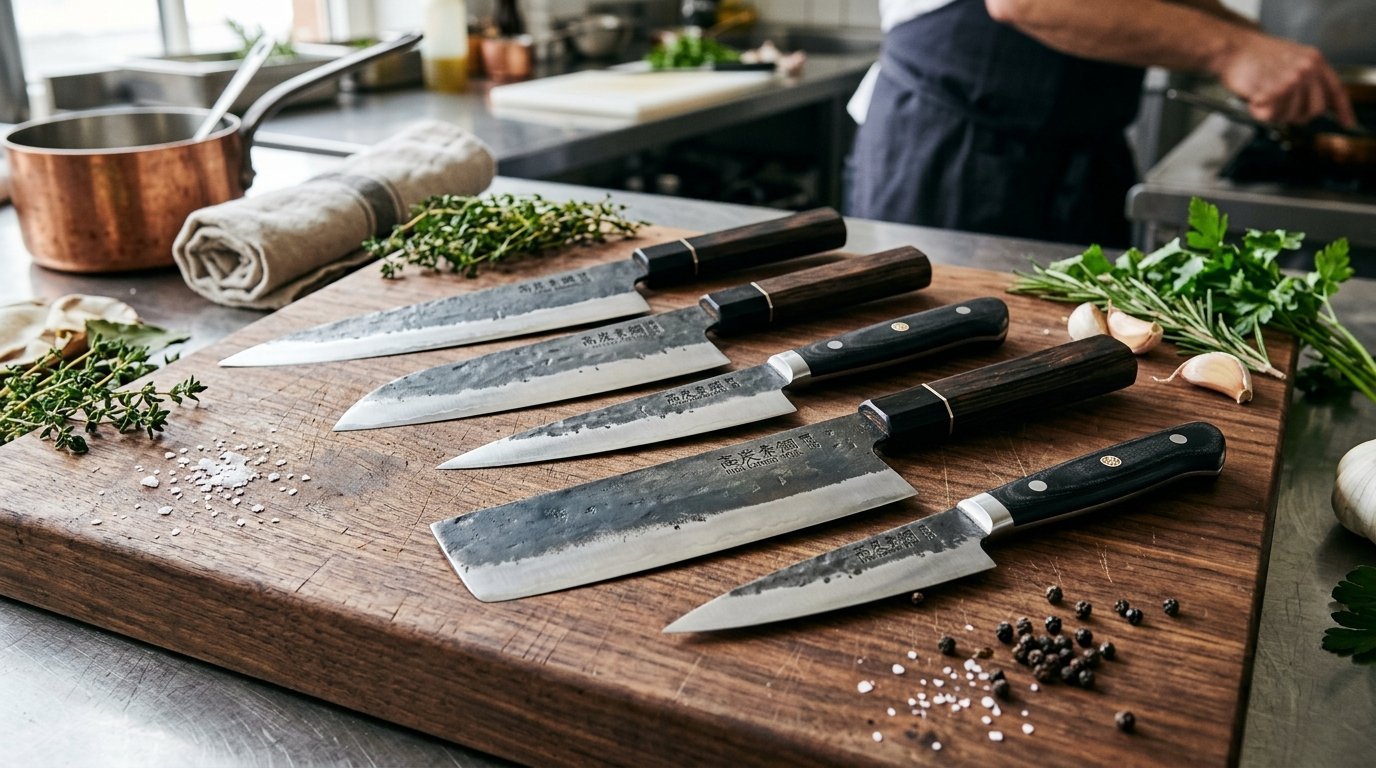
High carbon steel kitchen knives are made from steel with a lot of carbon (America’s Test Kitchen says “typically” more than 0.5 percent; Hunker says at least 0.8 percent). The sources say they take a very sharp edge and are easy to sharpen, but they rust and stain unless you wash and dry them right away, and they can chip. Choose one if you enjoy the upkeep. Choose stainless if you want a low-maintenance knife. Also watch the label: “high carbon” does not always mean “not stainless.”
Read More: What Angle to Sharpen Kitchen Knives: 15° vs 20° Guide
What “High Carbon Steel” Really Means
| Source | How it defines or uses the term |
| America’s Test Kitchen (2021) | “Carbon steel” can mean steel with high carbon, or any steel that is not stainless. Steel is “typically” high-carbon above 0.5 percent carbon. VG-10 has about 1 percent carbon and 15 percent chromium, so it is both high-carbon and stainless |
| Hunker | High-carbon knives have at least 0.8 percent carbon; ultra-high carbon runs 1.25 to 2 percent |
| Knivesandtools (retailer) | Carbon steel spans about 0.05 to 2.1 percent carbon. Manufacturers often label anything non-stainless as carbon steel. Stainless means at least 11 percent chromium |
| Gear Patrol (expert: Magnus Pettersson, KnifeAid) | Around 0.8 percent carbon and higher is “very reactive” to rust; 0.3 to 0.8 percent rusts less and is easier to maintain |
The label trap: the sources use the term differently. ATK says VG-10 is both high-carbon and stainless, while the Koi Knives post lists VG10 as “high carbon” next to stainless as if they were opposites. If a listing says “high carbon,” check whether it also says stainless and what the steel is called (for example VG-10, X50CrMoV15 or Blue #2). Knivesandtools lists X50CrMoV15 and VG10 as stainless and Aogami (Blue Paper), 1074 and 1095 as carbon steel.
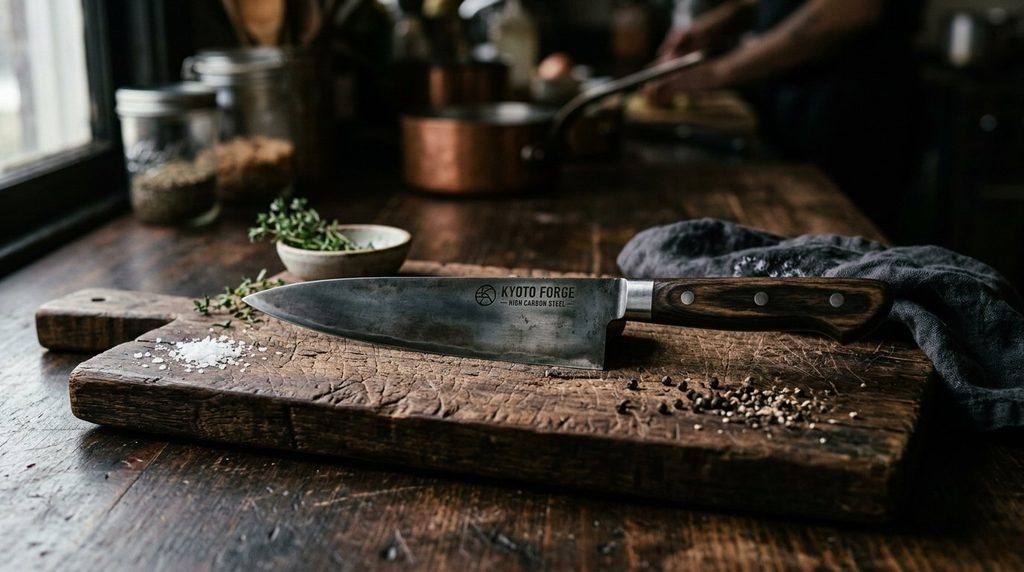
Pros and Cons
Pros (per the sources)
- Sharp edge. Hunker says the blade is harder than stainless and takes a sharper edge that’s easy to maintain.
- Easy to sharpen. Gear Patrol’s expert says carbon steel is easier to sharpen by hand than stainless because the metal “rubs off more cleanly” and chips less easily. (Hunker and ATK instead describe carbon steel as more brittle, so sources differ on chipping.)
- Edge feel. America’s Test Kitchen quotes one cook finding it “much easier to bring to a fiercely keen edge,” and says proponents find it holds a fine edge longer.
- A patina that develops with use, which many owners enjoy (ATK gyuto review).
Cons
- Rust and stains. Hunker says it has very little chromium and shows wear more readily. Koi Knives says citrus can cause patina or rust and onion or garlic can stain it.
- More upkeep. ATK says blades must be wiped dry from time to time during use.
- Brittleness. Hunker says carbon steel is more likely to chip or dent if dropped. Koi Knives says it can chip on bones or frozen food.
- Frequent sharpening. One cook quoted by ATK says it needs frequent sharpening to keep the edge, which conflicts with the “stays sharp” claim from another cook in the same article. The sources do not settle this.
High Carbon Steel vs Stainless Steel
| High carbon steel | Stainless steel | |
| Rust resistance | Low; needs drying and oiling | High; chromium at 11 percent or more (ATK, Knivesandtools) |
| Maintenance | Wipe during use, dry after washing, oil for storage | Low maintenance (ATK) |
| Sharpness and edge | Takes a keen edge (Hunker, ATK) | Koi Knives says softer and dulls a bit faster; Knivesandtools says VG10 stainless can be harder than most stainless |
| Toughness | More brittle (Hunker, ATK) | Koi Knives says less brittle and handles heavier work |
| Looks over time | Develops a patina | Stays clean |
Mixed options exist. Koi Knives (a seller promoting its own hybrid blades) describes carbon cores with stainless cladding as a middle ground. ATK’s gyuto test included one such knife, the Kohetsu Blue #2 (carbon core, stainless-clad), though it was not a winner.
What the Tests Found
- ATK’s gyuto test (published December 2025): tested 11 knives with 210 mm blades, including carbon-steel models (Togiharu Virgin Carbon Steel, Morihei Hisamoto Hagane SK, Naozumi Nihonkou SK, Kohetsu Blue #2). Both co-winners (Hitohira FJ VG10 and Masamoto Sohonten VG) and the Best Buy (Kanetsugu AUS-8A) were stainless or stain-resistant. None of the winners was carbon steel. ATK adds that performance depends on alloy, forging and heat treatment, not just carbon versus stainless.
- ATK’s chef’s knives under $75 test (July 2026): the review said almost all knives in that price range are stainless. Its winner was the Victorinox Fibrox Pro 8-inch ($47 at Amazon at time of listing), with the Mercer Millennia (usually under $30) as Best Buy.
What this means: I found no hands-on test where a carbon-steel knife beat the stainless options. That doesn’t prove carbon steel is worse, since ATK’s tests measured sharpness, blade design and handle comfort, not years of care. I haven’t tested any of these knives myself, and I did not find prices for the carbon-steel models.
Who Should Buy a High Carbon Steel Knife?
| You… | Better choice |
| Don’t mind wiping the blade while cooking | High carbon |
| Like sharpening and want an easy-to-sharpen blade | High carbon |
| Want a knife you can leave in the sink or rinse and forget | Stainless |
| Cut a lot of acidic foods like tomatoes and citrus without time to wipe | Stainless, or a stainless-clad blade |
| Want the best of both | A stain-resistant or carbon-core, stainless-clad knife |
Gear Patrol’s expert puts the caveat plainly: if you mind wiping the blade during cooking or dealing with a little rust, a stainless steel knife is the better choice.
What to Check Before You Buy
- The named steel, not just “high carbon.” Look for a name (VG-10, X50CrMoV15, Blue #2, 1095) and check if the seller calls it stainless or not.
- Carbon content and rust tendency. Gear Patrol’s expert says about 0.8 percent and higher is very reactive; 0.3 to 0.8 percent rusts less.
- Handle. ATK’s care notes say wood handles need occasional oiling to prevent drying and cracking.
- Return policy and warranty. I did not research specific brands’ warranties, so check the seller’s terms.
- Storage. Gear Patrol’s expert warns that knife blocks trap moisture; he uses a wall-mounted magnetic strip, or wraps knives in cloth or paper. Chef Knives To Go warns that magnetic bars can scratch or chip a fine edge. The sources conflict, so pick a dry, protected spot.
- Price and use. ATK’s under-$75 review suggests most knives at that price are stainless, so a carbon-steel knife may cost more or come from specialty makers. I found no price comparison.
How to Care for a High Carbon Steel Knife
- Wash by hand and dry right away. Hunker and Chef Knives To Go both say to do this to prevent rust.
- Wipe during use, especially after tomatoes, citrus and onions (Chef Knives To Go).
- Oil before storage. Hunker says a few drops of food-grade mineral oil on the blade. Gear Patrol’s expert recommends mineral oil, noting other oils can turn sticky and resinous. Chef Knives To Go says camellia oil also works.
- Let a patina form, or start one. Gear Patrol’s expert says to rub vinegar, instant coffee or potato onto the blade. Knifewear (a retailer) describes soaking the blade in cold, very strong instant coffee for 6 to 24 hours, and warns that a forced patina permanently changes the finish.
- Use soft boards. Chef Knives To Go recommends wood or soft plastic, not glass, granite or composite.
- Skip the dishwasher.
- Hone and sharpen. Chef Knives To Go says to use a ceramic honing rod and sharpen on water stones when honing no longer works.
Patina or rust?
| Looks like | What it is | Source |
| Gray, blue or brown, even | Patina, normal | Chef Knives To Go |
| Orange, rough or powdery | Rust; remove it | Chef Knives To Go |
For light rust, Chef Knives To Go suggests a paste of Bar Keepers Friend or baking soda and water, worked in gently with a soft cloth, then rinsed and dried fully. Deeper rust or pitting may leave permanent marks, so catch it early. Chef Knives To Go, Knifewear and Knivesandtools are all retailers, so their product mentions are partly marketing, though the care steps agree across them.
Common Mistakes
- Leaving the knife wet after cutting acidic food (Chef Knives To Go, Knifewear).
- Buying on the words “high carbon” alone, when the steel may be stainless.
- Using it on bones or frozen food, which risks chipping (Koi Knives, ATK).
- Storing it damp in a block or saya.
- Over-polishing a forced patina, which can remove a black kurouchi finish (Knifewear).
Frequently Asked Questions
What are the best high carbon steel kitchen knives?
I couldn’t find a hands-on test that crowned a carbon-steel winner. ATK’s 2026 gyuto test tested four carbon-steel models, but its winners were stainless or stain-resistant. Compare reviews for the specific model.
Is high carbon stainless steel the same as carbon steel?
No. Stainless steel contains at least 11 percent chromium (Knivesandtools, ATK). “High carbon stainless” means stainless with high carbon, such as VG-10.
How much carbon is in high carbon steel?
ATK says more than 0.5 percent typically; Hunker says at least 0.8 percent.
Do high carbon steel knives stay sharp longer?
ATK says proponents say so, but also quotes a cook who says it needs frequent sharpening. The sources don’t settle it.
Are carbon steel knives hard to sharpen?
Gear Patrol’s expert says they are easier to sharpen by hand than stainless. Hunker says the edge is easy to maintain.
How do you stop a carbon steel knife from rusting?
Wash and dry it right after use, wipe it during cooking, and oil it before storage (Hunker, Chef Knives To Go, Knifewear).
Is patina safe?
The sources I read call it a normal protective layer and don’t raise a safety concern, but none of them address food safety directly.
Can you remove rust from a carbon steel knife?
Light rust, yes. Chef Knives To Go suggests a Bar Keepers Friend or baking soda paste. Deeper rust or pitting can leave marks.
Conclusion
High carbon steel kitchen knives are for people who accept some upkeep in return for a sharp, easy-to-sharpen edge. They rust if left wet, develop a patina, and can chip. Stainless knives are easier to maintain, and ATK’s recent tests found no carbon-steel winner, though its tests didn’t measure long-term care. Before buying, find the named steel, check whether it’s also stainless, and decide honestly whether you’ll wipe and dry the blade every time. If not, buy stainless or a stainless-clad knife.
1 thought on “High Carbon Steel Kitchen Knives: Pros, Cons and Buying”