
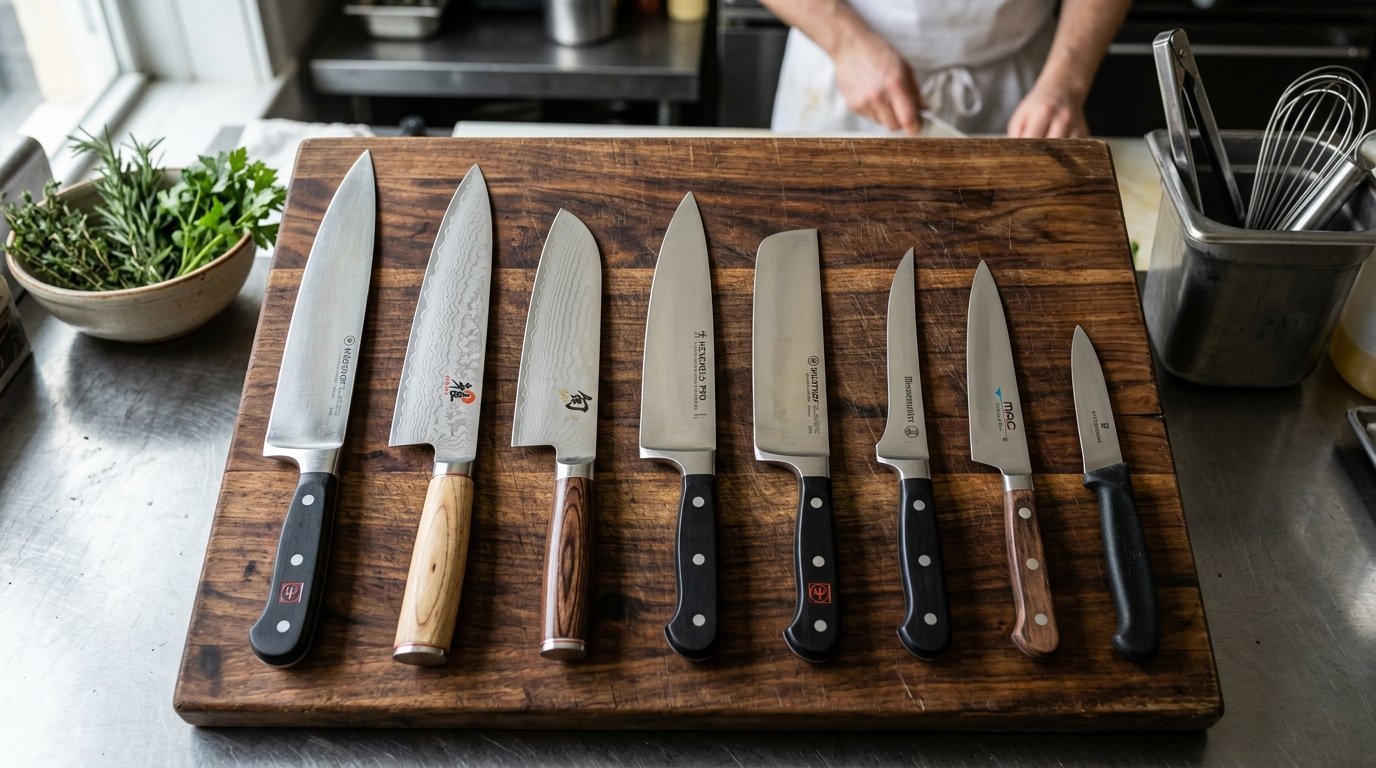
The main types of kitchen knives are the chef’s knife, paring knife, serrated (bread) knife, utility knife, boning knife, santoku, nakiri, cleaver, slicing (carving) knif,,e and steak knife. America’s Test Kitchen calls the chef’s knife, serrated kni,,fe and paring knife “The Big Three,” which together cover most tasks. You do not need a full block of knives to start.
Read More: High Carbon Steel Kitchen Knives: Pros, Cons and Buying
The Main Types of Kitchen Knives at a Glance
Blade lengths and descriptions are from Tasting Table and Work Sharp (a sharpener company). Where a source gave no length, I left it blank.
| Knife | Typical length | What it’s for |
| Chef’s knife | 8 to 10 in | All-purpose chopping, dicing, mincing, and slicing |
| Paring knife | About 3 in (Tasting Table) | Small, precise jobs: coring, peeling, trimming, deveining shrimp |
| Serrated / bread knife | 8 to 12 in (Work Sharp) | Bread, bagels and tomato skins |
| Utility knife | Under 6 in | Fruit, soft vegetables, sandwiches |
| Boning knife | Not stated | Separating meat and fish from bone; thin, flexible blade |
| Santoku | 6 to 7 in (Tasting Table) | Chopping, dicing, mincing; thin slices |
| Nakiri | About 6 in | Vegetable chopping; not for meat or dense vegetables |
| Slicing/carving knife | Up to 14 in (carving) | Even slices of cooked meat |
| Cleaver | Not stated | Heavy chopping (meat cleavers are thicker; vegetable cleavers lighter) |
| Steak knife | 4 to 5 in (Wüsthof) | Table use for steaks and chops |
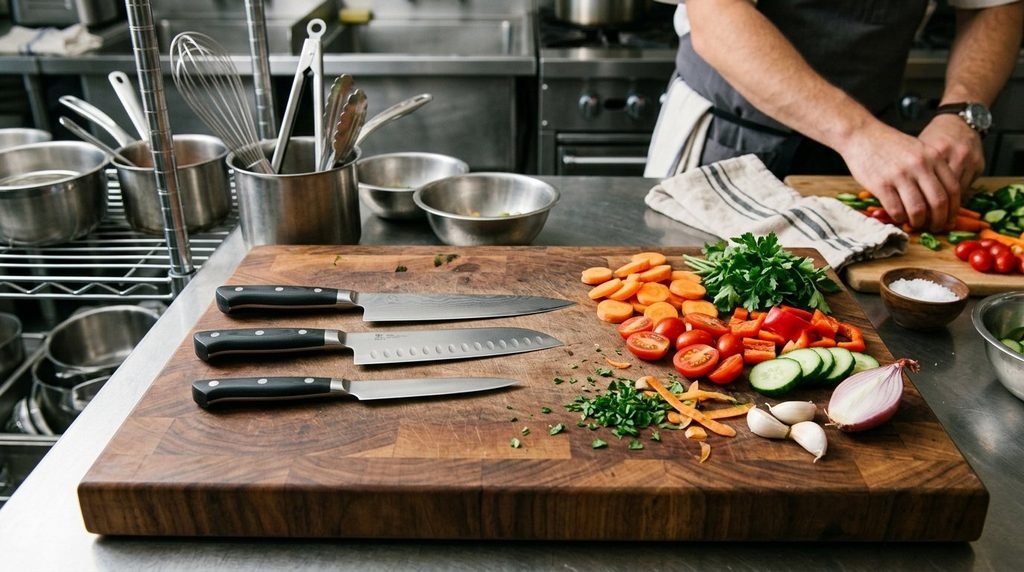
The Big Three: What Most Cooks Need
America’s Test Kitchen (updated October 2026) says the chef’s knife, serrated knif,e and paring knife cover most tasks.
| Knife | Why it’s essential | ATK pick from its tests |
| Chef’s knife | Does most of the cutting | Victorinox Fibrox Pro 8-inch, 755 test); Mercer Millennia is Best Buy at usually under $30 |
| Serrated knife | Cuts crusty bread, bagels and tomatoes without crushing | Not covered in the pages I read |
| Paring knife | Precision work in the hand | A separate Victorinox paring knife costs about $8, per ATK’s knife set page |
A separate ATK lesson (“What’s in Your Knife Block”) lists four core knives, adding a slicing (carving) knife for cooked meat to the three above. Treat it as optional unless you roast often. That slicing-knife entry is a members’ feature, so I couldn’t read its details.
Types Explained, One by One
Chef’s knife
All-purpose, 8 to 10 inches (Tasting Table). Food Republic says it is curved toward the tip so you rock it while chopping, is double-beveled and has a bolster, and can handle practically any kitchen task, including thick meat and squash. Work Sharp notes it can be hard to find one in a size that suits your hand.
Paring knife
A small knife for small jobs. Work Sharp says it comes in three styles: spear-tip for slicing, sheep’s foot for julienning and bird’s beak for peeling.
Serrated (bread) knife
Long, thin and always serrated (Work Sharp). ATK says pointed serrations cut cleanly through crusty bread, bagels and tomato skins.
Utility knife
Tasting Table says under 6 inches, for fruit and soft vegetables. Work Sharp calls it very versatile and meant to replace several other knives, but less precise than a dedicated knife.
Boning knife
A thin, flexible blade (Tasting Table, Work Sharp). Used to cut close to the bone with minimal waste.
Santoku
A lighter, thinner Japanese all-purpose knife of 6 to 7 inches. Its name refers to “three uses”: chopping, dicing and mincing (Tasting Table). Food Republic says it isn’t ideal for heavy work like cutting meat or dense vegetables such as potatoes.
Nakiri
A thin, flat-edged vegetable knife of about 6 inches for herbs, garlic and onions. Not for meat or dense vegetables (Tasting Table).
Slicing or carving knife
A narrow blade for even slices of cooked poultry and meat (Tasting Table). Work Sharp describes a straight, non-serrated blade with a spear-like tip.
Cleaver
A heavy, rectangular blade. Meat cleavers are thicker and vegetable cleavers lighter (Tasting Table).
Steak knife
A small knife for the table. Work Sharp says they are sold in sets of 4 to 8 and may be serrated or straight.
Less common knives
Tasting Table also covers the yanagiba (slicing raw fish for sushi), salmon knife, tomato knife, peeling knife, fillet knife and oyster knife. Most home cooks won’t need these.
Chef’s Knife vs Santoku: Where Sources Disagree
| Food Republic | MasterClass | |
| Length | Chef’s knife about 8 in and heavier; santoku shorter and lighter | Chef’s knife generally longer; santoku varies by model |
| Blade shape | Chef’s knife curved for rocking; santoku flat for up-and-down chopping | Santoku described as curved; chef’s knife with a pointed tip |
| Bevel | Santoku “traditionally single-beveled”; chef’s knife double-beveled | Santoku described as single bevel |
| Steel | Not covered | Santoku usually carbon steel; chef’s knife usually stainless |
The sources disagree on blade shape and don’t agree on steel. I haven’t verified bevel or steel claims against a manufacturer, so check the specific model’s listing before you buy. Both sources agree that the choice largely comes down to preference.
Which Knives Should You Buy? (By Cook)
| If you… | Start with |
| Are setting up a first kitchen | The Big Three: chef’s knife, bread knife, paring knife |
| Mostly chop vegetables | A chef’s knife, or a nakiri if you want a dedicated vegetable knife |
| Bake or eat a lot of bread | Add a serrated knife |
| Cut up whole chickens or fish | Add a boning or fillet knife |
| Roast large cuts | Add a slicing knife |
| Want a lighter, thinner knife | Try a santoku |
Knife Sets vs Buying Individually
America’s Test Kitchen (updated October 9, 2026) says:
- Sets suit people replacing a mix of worn-out knives in one purchase.
- Buying individually suits people who want to research each blade or spend less upfront.
- Brands rarely make the best version of every knife, so ATK’s top picks per category often come from different brands.
- Savings from sets range up to 38 percent, but one set cost more than buying the same pieces separately.
| ATK set pick | Contents/savings |
| Winner: Victorinox 4-Piece Fibrox Set | 8-inch chef’s, bread knife, 6-inch utility, 4-inch paring; 13.4% savings |
| Upgrade: Shun Premier 5-Piece In-Drawer Set | 21.5% savings |
| Best Buy: Mercer Millennia 3-Piece Starter Set | Under $100 per ATK; buying the three separately can cost less |
| Also recommended | Mac Professional PRO-31, Zwilling Pro 7-Piece Block Set, Wüsthof Classic 3-Piece Starter Set, Messermeister Oliva Elite 5-Piece, Friedr. Herder Madera 3-Piece |
ATK didn’t list exact prices for most sets, so check current retail prices.
Work Sharp’s warning is similar: quantity can come at the cost of quality, so buy only the knives you will use.
How to Choose the Right Knife
- Pick the job first. A knife you reach for daily matters more than a rare one.
- Check the handle and size. Work Sharp notes that a chef’s knife can be hard to find in a size that suits you.
- Compare steel and care. Stainless is easier to maintain than carbon steel (see ATK on carbon steel).
- Don’t buy a big block. ATK says a block isn’t required.
- Check the price against tests. ATK found a 47Victorinoxasitstopunder-75 chef’s knife.
Care Basics
America’s Test Kitchen’s chef’s knife review advises:
- Don’t put knives in the dishwasher.
- Sharpen when dull and hone between sharpenings with a honing steel.
- Use a blade guard when carrying a knife.
- Avoid cutting bone or frozen foods with harder, premium steels, which can chip.
Limits of This Article
- I did not test any knives myself.
- ATK’s “Big Three” pages gave no ATK picks for a serrated knife in what I read, and the page covering the four-knife list is partly members-only.
- Blade lengths vary by source, and some weren’t stated.
- Bevel and steel claims about santokus conflict between sources
Frequently Asked Questions
What are the types of kitchen knives?
Chef’s, paring, serrated, utility, boning, santoku, nakiri, slicing, cleaver and steak knives are the common ones.
What knives do I need in my kitchen?
ATK says the chef’s knife, serrated knife and paring knife cover most tasks.
What is the best all-purpose kitchen knife?
The chef’s knife. ATK’s top pick in its under-$75 test was the Victorinox Fibrox Pro 8-inch.
What size chef’s knife should I buy?
8 to 10 inches per Tasting Table. ATK’s picks in the sources I read were 8-inch models.
What is the difference between a paring knife and a utility knife?
A paring knife is about 3 inches for small precise work. A utility knife is under 6 inches for fruit, soft vegetables and sandwiches (Tasting Table, Work Sharp).
What is a bread knife used for?
Bread, bagels and tomatoes. ATK says its serrations cut through crusts and tomato skins cleanly.
What is a boning knife used for?
Removing meat from bones and trimming (Work Sharp). It is thin and flexible.
What is a santoku knife used for?
Chopping, dicing and mincing, with thin slices. Food Republic says it isn’t ideal for heavy work.
Is a santoku better than a chef’s knife?
Neither source says so. Both say the choice is mainly preference.
Conclusion
Most kitchens need only three knives: a chef’s knife, a serrated knife and a paring knife. Add a boning, slicing or vegetable knife only when your cooking calls for it. A 47VictorinoxtoppedAmerica’sTestKitchen’sunder-75 chef’s knife test, so a good start doesn’t need to cost much. Skip big sets unless you are replacing several worn knives at once, and check blade shape, size and care needs before you buy.
1 thought on “Types of Kitchen Knives: Names, Uses, and What You Need”