
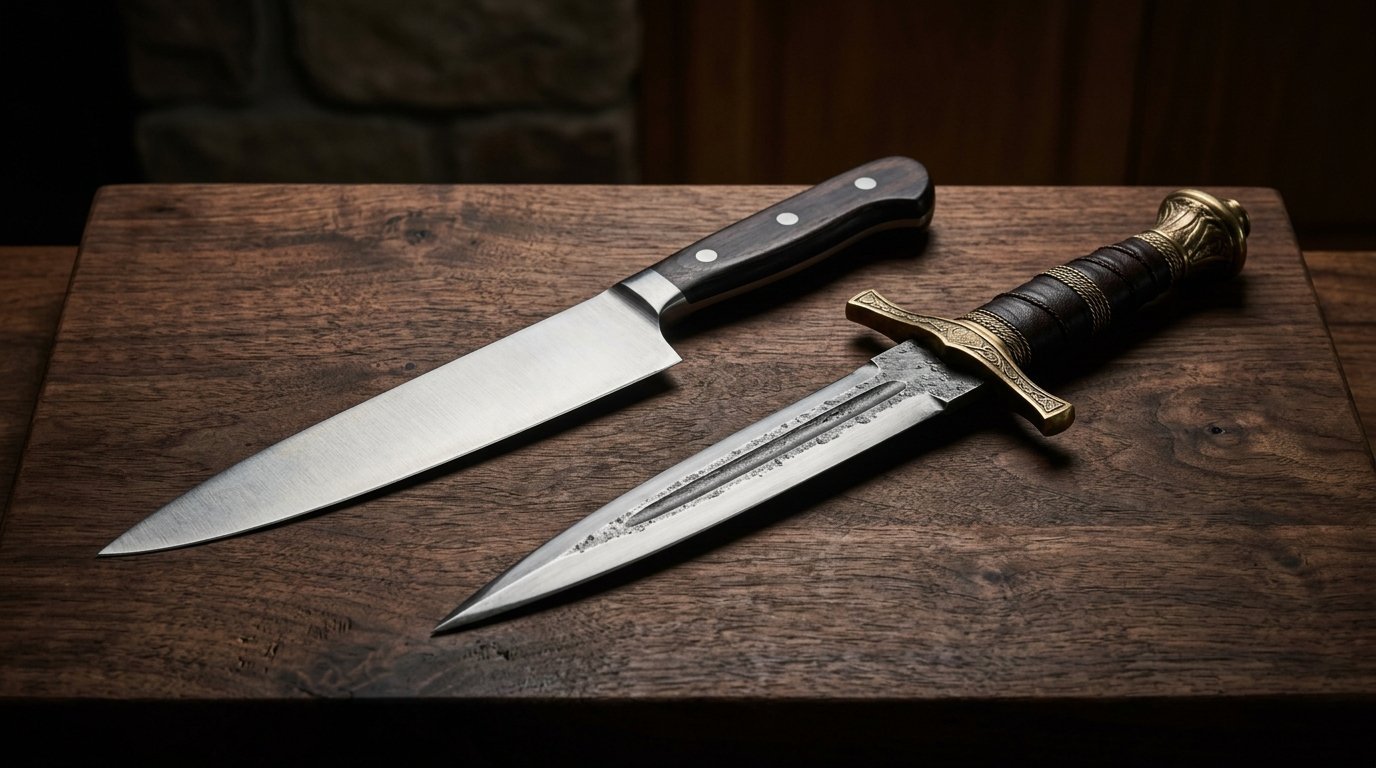
Kitchen knives and daggers are both bladed tools, but they are designed for very different purposes. A kitchen knife is primarily used to prepare food, while a dagger is traditionally designed as a close-combat weapon. Although the two may share certain physical features, their blade geometry, construction, intended use, and safety considerations distinguish them.
Understanding the differences between a kitchen knife and a dagger helps clarify their roles in cooking, historical weaponry, collecting, and everyday life.
Read More: Kitchen Knife vs Chef Knife: Key Differences, Uses, and Which One to Choose
What Is the Difference Between a Kitchen Knife and a Dagger?
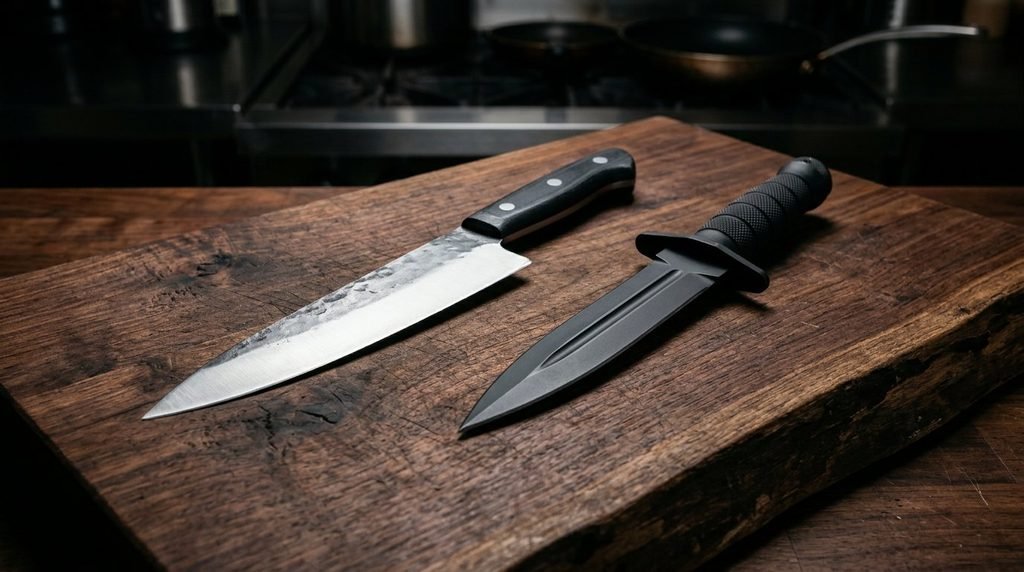
The main difference between a kitchen knife and a dagger is their intended function. Kitchen knives are optimized for cutting ingredients efficiently and precisely, whereas daggers are traditionally designed for use as weapons.
| Feature | Kitchen Knife | Dagger |
| Primary purpose | Food preparation | Historical and modern weapon use |
| Blade design | Varies by culinary task | Typically narrow and pointed |
| Cutting edges | Usually one primary edge | Often double-edged |
| Blade shape | Straight, curved, broad, or narrow | Commonly symmetrical and tapered |
| Handle design | Optimized for grip and food preparation | Designed for weapon handling |
| Common materials | Stainless steel, carbon steel, ceramic | Steel and other materials, depending on design |
| Typical setting | Kitchens and restaurants | Historical collections, museums, and regulated environments |
| Maintenance | Cleaning, sharpening, and food-safe storage | Depends on material, finish, and intended use |
These characteristics are general rather than universal. Some kitchen knives have pointed tips, and some daggers have a single cutting edge. The intended purpose and overall design are more informative than any single feature.
Kitchen Knife vs Dagger: Blade Design and Shape
Blade geometry is one of the most noticeable differences between these two types of blades.
Kitchen Knife Blade Design
Kitchen knives come in a variety of shapes because different foods require different cutting techniques. A chef’s knife typically has a broad blade suitable for chopping vegetables, slicing meat, and mincing herbs. A paring knife has a smaller blade for detailed work, while a bread knife uses a serrated edge to cut through crusty surfaces.
The blade’s shape, edge angle, and length are selected to balance cutting efficiency, control, and durability.
Dagger Blade Design
A traditional dagger generally features a narrow blade that tapers toward a sharp point. Many historical examples have two cutting edges and a symmetrical profile. This configuration reflects the dagger’s traditional role as a weapon rather than a culinary implement.
Daggers also vary across cultures and historical periods. Their blade shape, guard, handle, and decorative features depend on their origin and intended function.
| Blade characteristic | Kitchen Knife | Dagger |
| Shape | Task-specific | Often tapered and symmetrical |
| Tip | Varies by knife type | Usually pronounced and pointed |
| Edge geometry | Optimized for food cutting | Often designed for weapon use |
| Design priority | Precision and cutting efficiency | Weapon functionality and, sometimes, ceremonial appearance |
Kitchen Knife vs Dagger: Primary Uses
The two tools are best understood through the activities they are intended to perform.
| Use case | Kitchen Knife | Dagger |
| Chopping vegetables | Yes | No |
| Slicing bread | Yes, with a suitable blade | No |
| Preparing meat and fish | Yes | No |
| Peeling and trimming ingredients | Yes, with an appropriate knife | No |
| Historical reenactment | Not its primary role | May be used with suitable replicas and precautions |
| Historical collection | Sometimes collected | Commonly collected as a historical artifact |
| Decorative display | Possible | Common for ornamental examples |
A kitchen knife should be selected according to the food preparation task. A dagger is more appropriately considered in the context of history, collecting, or lawful ceremonial use.
Neither tool should be treated as a substitute for the other.
Kitchen Knife vs Dagger: Materials and Construction
Both kitchen knives and daggers can be made from steel, but the materials and construction methods vary according to their intended applications.
Kitchen knives commonly use stainless steel because it offers good corrosion resistance and relatively straightforward maintenance. Carbon steel is also popular among cooks who value its sharpening characteristics, although it generally requires more attention to prevent rust. Ceramic blades are another option for certain culinary tasks.
Daggers are often made from carbon steel, stainless steel, or other metals, depending on the period and design. Historical examples may include distinctive metalwork, ornamental fittings, or handles made from wood, bone, or other materials.
| Material or component | Kitchen Knife | Dagger |
| Stainless steel | Common | Used in some modern examples |
| Carbon steel | Common | Common in many historical and modern designs |
| Ceramic | Used in some culinary knives | Not typical of traditional daggers |
| Handle materials | Wood, plastic, composite, metal | Wood, metal, bone, composite, and decorative materials |
| Construction priorities | Edge performance, hygiene, balance | Structural integrity, historical design, or decorative value |
Material alone does not determine quality. Heat treatment, manufacturing standards, maintenance, and the specific design all influence performance and longevity.
Kitchen Knife vs Dagger: Which Is Sharper?
There is no universal answer to which is sharper. Sharpness depends on the condition of the edge, its geometry, the steel or other blade material, and the quality of manufacturing and maintenance.
Kitchen knives are designed to achieve effective cutting performance on food. A properly maintained chef’s knife can make clean, precise cuts through vegetables, meat, and other ingredients.
Daggers may have sharp edges and pointed tips, but their geometry and intended use differ from those of culinary blades. A pointed blade is not necessarily sharper along its cutting edge, and a double-edged design does not automatically make a blade more effective at every cutting task.
| Factor | Kitchen Knife | Dagger |
| Edge sharpness | Depends on blade type and maintenance | Depends on design and condition |
| Cutting performance | Optimized for culinary tasks | Varies according to design |
| Edge configuration | Usually one primary edge | Frequently two edges |
| Maintenance focus | Cleanliness, corrosion prevention, sharpening | Condition, corrosion prevention, and appropriate storage |
Sharpness should therefore be evaluated in relation to the tool’s intended purpose rather than its appearance.
Kitchen Knife vs Dagger: Safety and Handling
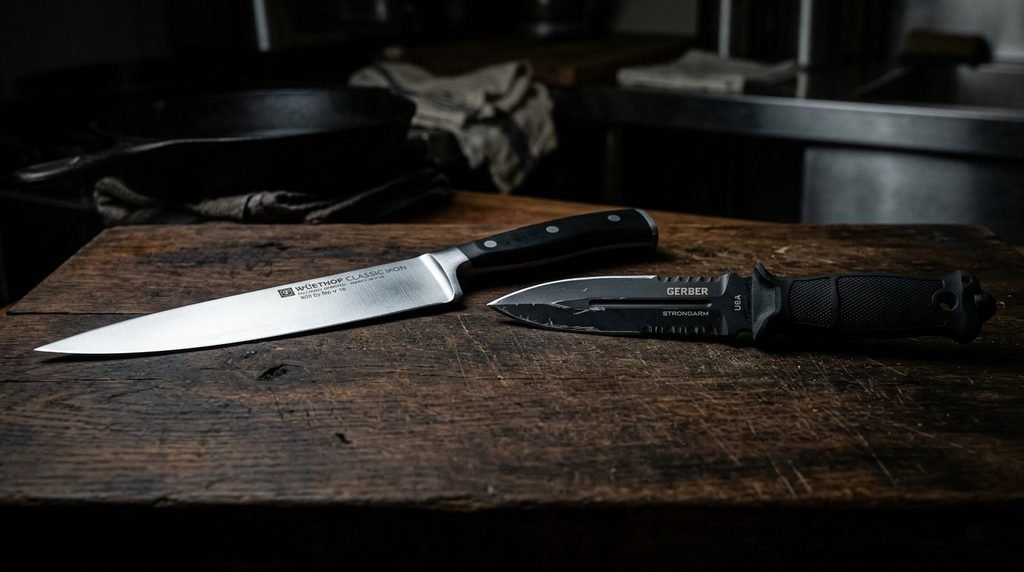
Both kitchen knives and daggers can cause serious injuries if handled carelessly. Safe storage and responsible handling are essential, regardless of the blade’s size or design.
Kitchen knives should be stored securely, kept clean, and used on stable cutting surfaces. Appropriate cutting techniques and a suitable knife for the task help reduce accidents.
Daggers require additional caution because they are designed as weapons or weapon-like objects. Their possession, transportation, display, and use may be subject to local laws and regulations. Collectors should understand the rules that apply in their jurisdiction.
| Safety consideration | Kitchen Knife | Dagger |
| Safe storage | Knife block, sheath, or secure drawer insert | Secure, appropriate sheath or display storage |
| Handling | Controlled food preparation | Careful handling away from other people |
| Transportation | Protect the edge and follow applicable rules | Check local restrictions and transportation laws |
| Appropriate environment | Kitchen or food preparation area | Lawful collection, display, or authorized activity |
A blade should never be used to threaten or injure another person. Safe handling and compliance with applicable laws are important for both categories.
Kitchen Knife vs Dagger: Historical Background
Kitchen knives have developed alongside cooking practices, food production, and advances in metallurgy. Different cultures developed specialized knives for preparing vegetables, cutting meat, filleting fish, and performing other culinary tasks.
Daggers have a separate historical tradition. They appeared in many societies as weapons, personal sidearms, ceremonial objects, and symbols of status. Their shapes and decorative details often reflected the craftsmanship and traditions of the cultures that produced them.
Over time, both categories evolved as materials and manufacturing techniques improved. Modern kitchen knives emphasize culinary performance and ease of maintenance, while contemporary daggers may be produced for historical interpretation, collecting, decoration, or other purposes permitted by law.
Kitchen Knife vs Dagger: Which One Should You Choose?
The right choice depends entirely on your intended purpose.
| Your requirement | Appropriate choice | Reason |
| Everyday cooking | Kitchen knife | Designed for food preparation |
| Chopping and slicing ingredients | Chef’s knife or another suitable culinary knife | Matches common kitchen tasks |
| Peeling fruit or detailed trimming | Paring knife | Provides control for smaller tasks |
| Cutting bread | Bread knife | Serrated edge handles crusty surfaces effectively |
| Studying historical weapons | Historical dagger or documented replica | Relevant to historical research and collecting |
| Decorative historical display | Lawfully owned dagger or replica | Preserves the object’s historical or artistic appeal |
For cooking, choose a kitchen knife that matches the food and cutting technique. For historical study or collecting, consider a dagger’s provenance, condition, craftsmanship, and legal status.
Frequently Asked Questions
Is a kitchen knife the same as a dagger?
No. A kitchen knife is primarily designed for preparing food, while a dagger is traditionally designed as a weapon. Although both have blades and handles, their geometry and intended uses differ.
Do all daggers have double-edged blades?
No. Many traditional daggers are double-edged, but some have a single edge or other blade configurations. Designs vary across historical periods and cultures.
Can a kitchen knife have a pointed tip?
Yes. Many kitchen knives have pointed tips for specific culinary tasks. A pointed tip alone does not make a kitchen knife a dagger.
Are kitchen knives and daggers made from the same steel?
They can be. Both may use stainless steel or carbon steel, but the grade, heat treatment, construction, and finishing processes can differ significantly.
Which is better for everyday use?
A kitchen knife is the appropriate choice for everyday food preparation. A dagger is not designed to replace a chef’s knife, paring knife, or other culinary tool.
Conclusion
The comparison between a kitchen knife and a dagger comes down to purpose, design, and intended use. Kitchen knives are specialized tools developed to make food preparation efficient and precise. Daggers belong primarily to the history of weapons and may also serve as collectible or decorative objects.
Although they share some physical characteristics, they are not interchangeable. Understanding their differences helps readers appreciate their distinct functions, choose the right tool for an appropriate task, and handle bladed objects responsibly.
1 thought on “Kitchen Knife vs Dagger: Key Differences, Uses, and Design”