
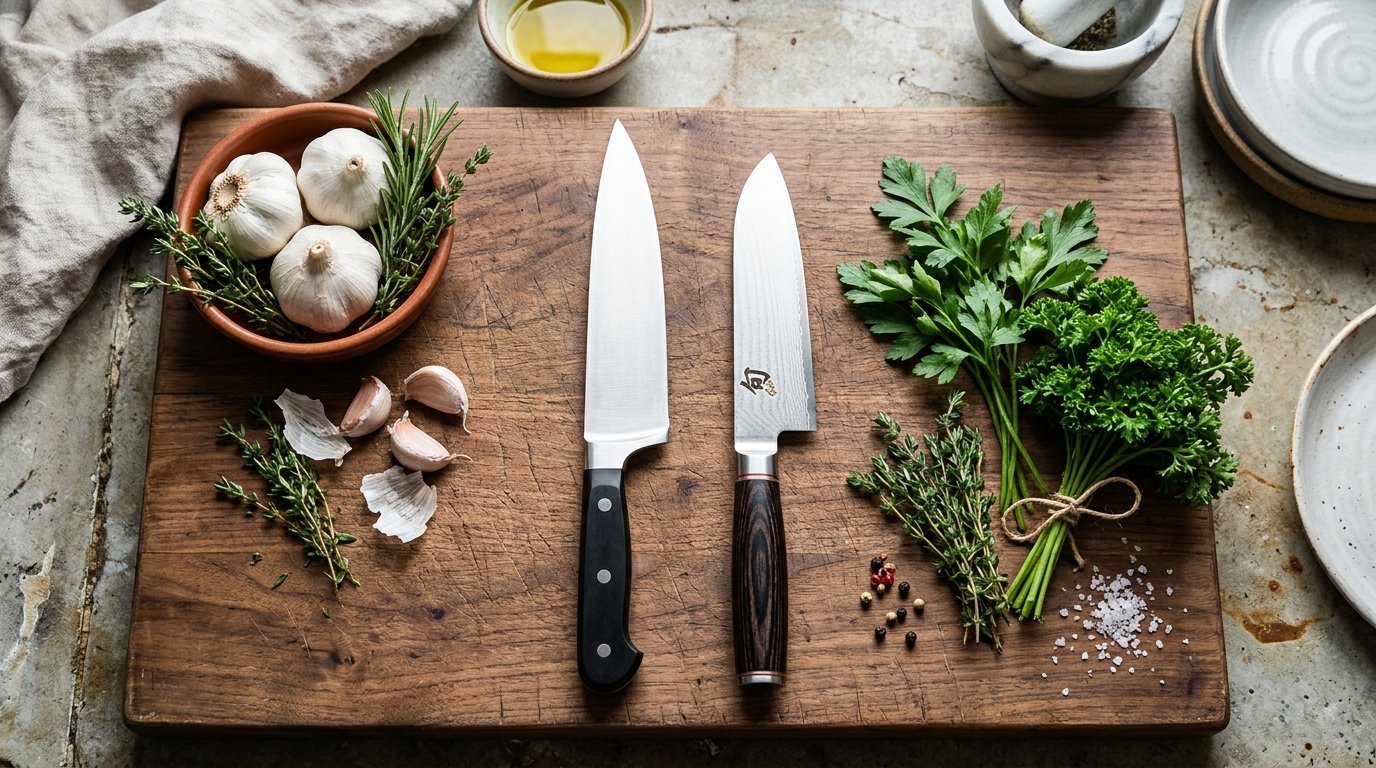
Choosing between a kitchen knife and a Santoku can be confusing, especially when both are designed for everyday food preparation. While a traditional Western chef’s knife is a versatile all-purpose tool, a Santoku knife excels at precise slicing, dicing, and chopping.
Understanding the differences in blade shape, cutting technique, comfort, and versatility can help you choose the right knife for your cooking style.
Read More: Kitchen Knife vs Dagger: Key Differences, Uses, and Design
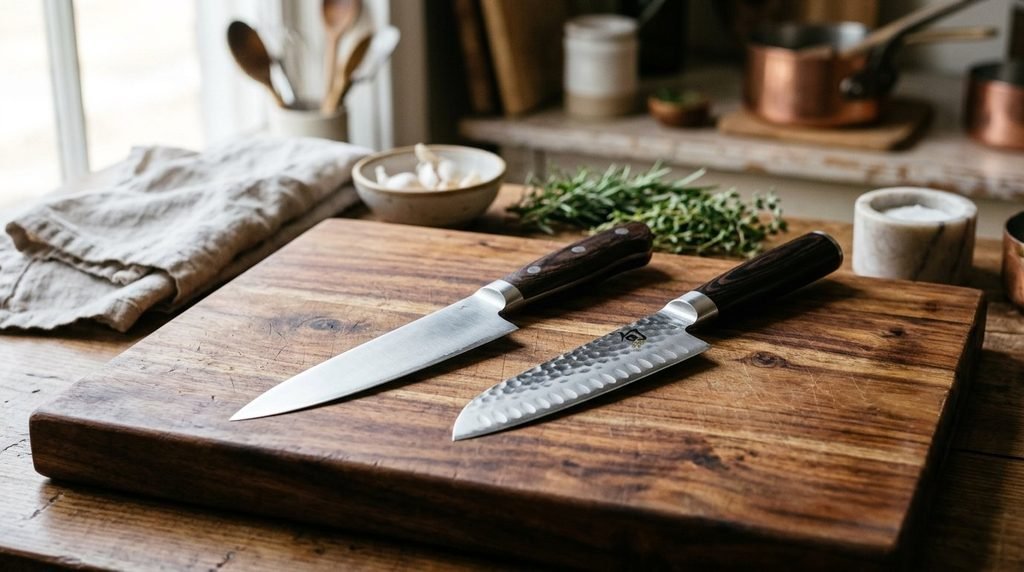
Kitchen Knife vs Santoku: What Is the Difference?
The term kitchen knife covers many types of knives, but in this comparison, it refers to the traditional Western chef’s knife. A Santoku is a Japanese-style multipurpose kitchen knife known for its shorter blade and flatter cutting edge.
| Feature | Chef’s Knife | Santoku Knife |
| Typical blade length | 8–10 inches | 5–7 inches |
| Blade shape | Curved edge with a pointed tip | Flatter edge with a rounded or lowered tip |
| Origin | Western culinary tradition | Japan |
| Best for | Rock chopping, slicing, and versatile prep | Chopping, slicing, and dicing |
| Cutting technique | Rocking, slicing, and push cutting | Up-and-down chopping and push cutting |
| Handling | Often suited to larger cutting motions | Often feels compact and precise |
| Blade weight | Varies; often heavier | Varies; often lighter |
| Best suited for | Cooks who want one versatile knife | Cooks who prioritize controlled, precise cutting |
Neither knife is universally better. The right choice depends on the foods you prepare, the way you cut, and which blade feels most comfortable in your hand.
Chef’s Knife vs Santoku: Blade Design and Shape
Blade geometry is one of the biggest differences between these knives. It affects how the knife moves through food and which cutting techniques feel natural.
Chef’s Knife Design
A Western chef’s knife typically features a curved cutting edge that rises toward a pointed tip. This curve makes it ideal for rocking the blade back and forth across a cutting board.
Its longer blade also provides room to handle large vegetables, herbs, meat, and other ingredients. Many models have a substantial handle and bolster, although construction varies by brand.
Santoku Knife Design
The Santoku usually has a shorter blade, a flatter cutting edge, and a tip that curves down toward the edge. Its shape encourages straight-down chopping and controlled push cuts rather than pronounced rocking motions.
Some Santoku knives feature granton-style indentations along the blade. These may help reduce sticking with certain foods, although their effectiveness depends on the blade design and ingredients.
| Blade characteristic | Chef’s Knife | Santoku |
| Edge curvature | More pronounced | Usually flatter |
| Tip | Pointed | Typically less pointed |
| Cutting motion | Rocking and push cutting | Chopping and push cutting |
| Precision work | Excellent | Excellent |
| Large ingredients | Often easier to manage | Depends on blade length |
Kitchen Knife vs Santoku for Chopping Vegetables
Both knives work well for vegetables, but they offer different advantages.
A chef’s knife is particularly useful for chopping large onions, splitting cabbage, cutting squash, and mincing herbs with a rocking motion. Its curved edge makes it easy to maintain a continuous chopping rhythm.
A Santoku is especially comfortable for repetitive, controlled cuts through onions, carrots, cucumbers, peppers, and other everyday vegetables. Its flatter edge allows more of the blade to contact the cutting board during a straight-down cut.
| Vegetable task | Better choice for many cooks | Why |
| Mincing herbs | Chef’s knife | Rocking motion is convenient |
| Dicing onions | Either | Both provide excellent control |
| Slicing cucumbers | Santoku | Compact blade suits repetitive slicing |
| Chopping cabbage | Chef’s knife | Longer blade accommodates larger ingredients |
| Cutting carrots | Either | Technique and blade sharpness matter most |
| Preparing small vegetables | Santoku | Compact design can feel easier to control |
Verdict: Choose a chef’s knife if you prefer rocking motions and handle large vegetables regularly. Choose a Santoku if you favor controlled chopping and a compact blade.
Chef’s Knife vs Santoku for Meat, Fish, and Herbs
The best knife also depends on the ingredients you prepare most often.
Meat
A chef’s knife is a strong all-purpose option for slicing boneless meat, trimming fat, and portioning larger cuts. Its longer blade can make long, smooth slices easier.
A Santoku also handles boneless meat well, particularly when making short, precise cuts. However, neither knife is a substitute for a dedicated boning knife when removing bones or performing detailed butchery.
Fish
A Santoku is useful for cutting fish into portions and preparing ingredients for everyday meals. A chef’s knife can handle many similar tasks.
For delicate raw fish preparation, such as traditional sushi or sashimi slicing, a dedicated Japanese fish knife may provide better results because its specialized blade is designed for particular cutting techniques.
Herbs
Both knives can mince herbs effectively. The chef’s knife is particularly convenient for rocking through parsley, cilantro, and basil, while a Santoku works well with a controlled chopping motion.
| Ingredient | Chef’s Knife | Santoku |
| Boneless meat | Excellent | Very good |
| Large meat portions | Often more convenient | Good, depending on size |
| Fish fillets | Very good | Very good |
| Delicate raw fish slicing | General-purpose option | General-purpose option |
| Fresh herbs | Excellent for rocking | Excellent for controlled chopping |
| Garlic and ginger | Excellent | Excellent |
Santoku vs Chef’s Knife: Pros and Cons
Before buying either knife, consider its strengths and limitations.
Chef’s Knife: Pros and Cons
Pros
- Versatile enough for most everyday kitchen tasks.
- Curved edge supports rocking cuts and efficient herb mincing.
- Longer blade is useful for larger vegetables and cuts of meat.
- Familiar design with a wide range of available models.
Cons
- Longer blades may feel cumbersome in smaller kitchens or hands.
- Some models are relatively heavy.
- The pronounced curve may be less comfortable for cooks who prefer straight-down chopping.
Santoku Knife: Pros and Cons
Pros
- Compact design offers excellent control for many everyday tasks.
- Flatter edge suits chopping and push-cutting techniques.
- Often feels lighter and easier to maneuver, depending on construction.
- Well suited to preparing vegetables, fish, and boneless meat.
Cons
- Shorter blades may be less convenient for large ingredients.
- Less suited to pronounced rocking motions.
- A flatter edge may not match every cook’s preferred cutting technique.
- Not designed for cutting through bones or frozen foods.
Which Is Easier to Use: A Chef’s Knife or Santoku?
Ease of use depends on your hand size, grip, experience, and preferred cutting motion rather than the knife’s name alone.
A Santoku may feel easier to control for beginners who prefer short, deliberate chopping movements. Its compact shape can also be appealing if you have limited counter space.
A chef’s knife may feel more natural if you use a rocking technique or regularly prepare large quantities of food. Its longer blade supports a broad range of cutting tasks without requiring you to switch knives frequently.
For beginners, prioritize a comfortable handle, a secure grip, a sharp edge, and a blade length that you can control safely. A well-balanced knife that feels comfortable is generally a better choice than one selected solely for its style or weight.
Kitchen Knife vs Santoku: Which Offers Better Value?
Both knives are available across budget, midrange, and premium price categories. Price alone does not determine cutting performance; steel quality, heat treatment, blade geometry, handle construction, and manufacturing consistency all matter.
| Buying consideration | Chef’s Knife | Santoku |
| Budget options | Widely available | Widely available |
| Premium options | Broad selection | Broad selection |
| Everyday versatility | Excellent | Excellent |
| Best value for a single knife | Ideal for varied cutting techniques | Ideal for cooks who prefer chopping |
| Long-term maintenance | Regular sharpening and proper care | Regular sharpening and proper care |
If you want one knife to handle a wide variety of ingredients and techniques, a chef’s knife is a dependable investment. If your cooking routine centers on vegetables, fish, and controlled slicing, a Santoku can offer equally strong value.
Can You Use a Santoku Instead of a Chef’s Knife?
Yes. A Santoku can replace a chef’s knife for most everyday food preparation, including chopping vegetables, slicing boneless meat, dicing onions, mincing garlic, and preparing herbs.
The main limitations are tasks that benefit from a longer blade or a pronounced rocking motion. Large ingredients may require more cuts, and cooks who rely on rocking techniques may find a Santoku less natural.
Similarly, a chef’s knife can perform most tasks assigned to a Santoku. You do not need both knives unless you prefer their different cutting characteristics or want a second tool for convenience.
Regardless of which knife you choose, avoid using either one to cut through bones, frozen food, or other materials that may damage the blade unless the knife is specifically designed for that purpose.
Chef’s Knife vs Santoku: Which Should You Buy?
Your cooking habits are the most reliable guide when deciding between the two.
| Your needs | Recommended knife |
| One knife for nearly every kitchen task | Chef’s knife |
| Frequent rocking cuts and herb mincing | Chef’s knife |
| Controlled chopping and push cutting | Santoku |
| Compact, easy-to-maneuver blade | Santoku |
| Frequent preparation of large vegetables | Chef’s knife |
| Everyday vegetable-focused cooking | Santoku |
| A second knife to complement an existing collection | Whichever suits your preferred technique |
If you are buying your first quality kitchen knife, a chef’s knife is often the most versatile starting point. However, a Santoku may be the better first purchase if its shape feels more natural and you primarily prepare vegetables and boneless proteins.
Whenever possible, handle both knives before buying. Comfort, balance, and cutting technique can make a greater difference to your experience than small differences in blade specifications.
Frequently Asked Questions
Is a Santoku better than a chef’s knife?
Neither is inherently better. A Santoku excels at controlled chopping and slicing, while a chef’s knife offers excellent versatility and is particularly well suited to rocking cuts and larger ingredients.
Why is a Santoku knife different from a regular kitchen knife?
A Santoku typically has a shorter blade, a flatter cutting edge, and a less pronounced tip. These features favor controlled chopping and push cutting, whereas a Western chef’s knife generally has a more curved edge for rocking motions.
Can a Santoku knife cut meat?
Yes. A Santoku can cut boneless meat, poultry, and fish into portions. For bones, detailed butchery, or specialized fish preparation, use a knife designed for the task.
Is a Santoku knife good for beginners?
Yes. Its compact shape and controlled cutting style can make it comfortable for beginners. A chef’s knife is also beginner-friendly when its length, weight, and handle suit the user.
Should I buy a chef’s knife and a Santoku?
You do not need both. Start with the knife that best matches your cutting style and cooking habits. Add the other later if its different blade geometry would make food preparation more comfortable or efficient.
Final Verdict: Kitchen Knife vs Santoku
The choice between a chef’s knife and a Santoku comes down to versatility versus preferred cutting style—not overall quality.
A chef’s knife is an excellent all-purpose choice for cooks who want a longer blade, a curved edge, and the flexibility to rock, slice, and chop. A Santoku is an equally capable option for those who prefer a compact blade and controlled chopping movements.
For most households, either knife can handle everyday food preparation. Choose the one that feels comfortable, stays sharp with proper maintenance, and matches the way you cook.