
If you’re shopping for premium stainless steel cookware, All-Clad D3 vs D5 is one of the most common comparisons to make. Both collections use All-Clad’s fully bonded stainless steel construction, are designed for long-term use, and are compatible with induction cooktops. The biggest difference is their construction: D3 uses three bonded layers, while D5 uses five.
So, which one should you buy?
The answer depends largely on how you cook, how much you value responsiveness versus heat stability, and whether the additional weight and construction of D5 justify its price for your kitchen.
Read More: Carote Cookware Dishwasher Safe: What You Need to Know
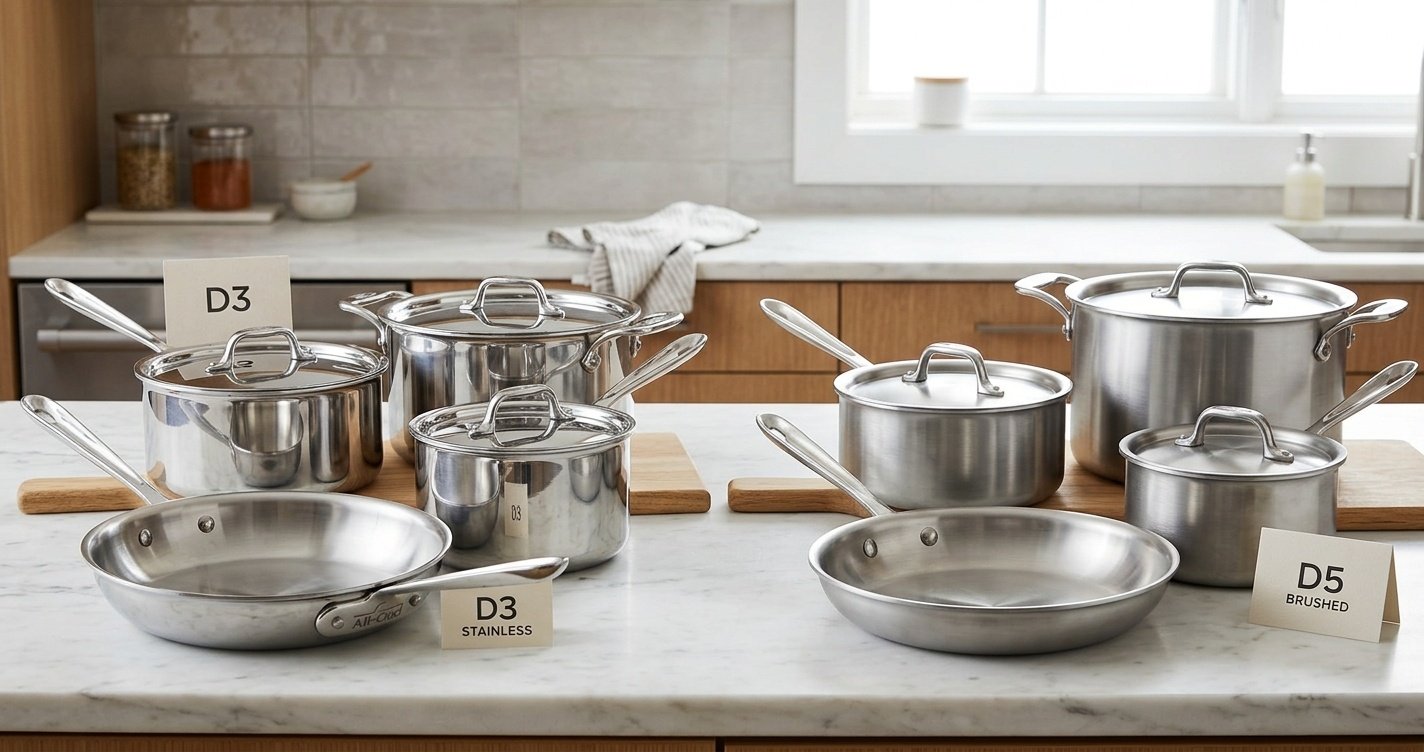
All-Clad D3 vs D5 at a Glance
| Feature | All-Clad D3 | All-Clad D5 |
| Construction | 3-ply | 5-ply |
| Core | Aluminum | Stainless steel + aluminum |
| Heat response | Faster | More gradual |
| Heat distribution | Even | Extremely even |
| Weight | Medium | Medium-heavy |
| Finish | Polished stainless | Brushed or polished |
| Induction compatible | Yes | Yes |
| Oven safe | Up to 600°F | Up to 600°F |
| Best suited for | Everyday cooking | Controlled, steady cooking |
All-Clad itself describes D3 as a responsive option with fast, even heating, while D5 emphasizes greater heat stability and control.
What Is All-Clad D3?
All-Clad D3 is the classic tri-ply stainless steel cookware line.
Its three bonded layers consist of a stainless steel cooking surface, an aluminum core, and a stainless steel exterior. The aluminum core helps the pan heat quickly and distribute heat evenly, while stainless steel provides durability and a neutral cooking surface.
Why choose D3?
D3 is particularly appealing if you want cookware that responds quickly when you change the burner temperature. That makes it useful for everyday techniques such as:
- Sautéing vegetables
- Searing meat
- Making pan sauces
- Cooking pasta sauces
- Browning ingredients
- General stovetop cooking
Another advantage is weight. All-Clad lists D3 as a medium-weight collection, compared with the medium-heavy D5 line.
For many home cooks, that makes D3 easier to maneuver when a pan is full of food.
What Is All-Clad D5?
All-Clad D5 increases the construction from three layers to five. Its alternating stainless steel and aluminum layers are designed to provide greater heat stability and evenness.
The additional construction changes how the cookware behaves on the stove. Instead of prioritizing rapid temperature changes, D5 is designed around steadier heat control. That can be useful when you’re simmering sauces, cooking delicate foods, or working with recipes where maintaining a consistent temperature matters.
D5 is also somewhat heavier than D3, which some cooks may appreciate for its substantial feel while others may find less convenient for everyday handling.
All-Clad D3 vs D5: What’s the Real Difference?
The difference isn’t simply that one has “more layers.” The extra layers influence the cooking characteristics of each collection.
1. Construction
D3 uses three layers:
Stainless steel → aluminum → stainless steel
D5 uses five:
Stainless steel → aluminum → stainless steel → aluminum → stainless steel
The result is a meaningful difference in thermal behavior. D3 emphasizes responsiveness, while D5 emphasizes stability and controlled heating.
2. Heat Responsiveness
If you frequently adjust your burner temperature, D3’s aluminum-centered construction gives it a responsive feel. D5 is designed to change temperature more gradually. That can be an advantage for cooks who want steady temperatures rather than rapid changes.
In practical terms, D3 tends to feel more responsive, while D5 tends to feel more controlled.
3. Weight
D5 contains more metal, and All-Clad categorizes it as medium-heavy compared with D3’s medium weight. That matters more than it may seem.
A lightweight skillet can be easier to move from stovetop to oven or to lift when pouring. A heavier pan can feel more substantial and stable on the cooktop.
4. Finish
Traditional D3 cookware has a polished stainless steel exterior.
D5 is available in both polished and brushed stainless steel versions. The brushed finish has a matte appearance that can be more forgiving of everyday fingerprints and marks, while polished stainless has the classic reflective All-Clad appearance. The finish is primarily an aesthetic consideration rather than a reason to expect dramatically different cooking results.
5. Handles
D5 cookware features oversized, double-riveted stainless steel handles, while D3 uses stainless steel riveted handles designed for a chef-style grip. If you’re comparing individual pans rather than complete sets, handle design is worth considering because you’ll interact with it every time you cook.
Which Is Better for Everyday Cooking?
For everyday cooking, D3 offers a combination of responsiveness, even heating, durability, and relatively manageable weight.
That makes it a natural choice for cooks who regularly prepare a wide range of meals and don’t specifically need the additional thermal stability of D5.
All-Clad also offers D3 Stainless Everyday, an online-exclusive variation with features such as redesigned handles, drip-free pouring rims, and larger skillet surface area. Which Is Better for Sauces and Delicate Foods?
D5’s emphasis on heat stability can make it attractive for recipes where maintaining consistent temperatures is important.
Think of foods such as:
- Cream sauces
- Custards
- Reductions
- Long simmers
- Temperature-sensitive dishes
All-Clad specifically describes D5 as offering enhanced heat stability and control, while D3 is designed for faster heat response.
Which Is Better for Searing?
Both D3 and D5 are capable stainless steel cookware options for searing. The important factors include preheating the pan properly, using an appropriate amount of cooking fat, and allowing food to develop a crust before attempting to move it.
D3’s faster responsiveness can be appealing if you like actively controlling the burner during cooking. D5’s greater thermal stability can appeal to cooks who prefer a steadier cooking environment.
Are All-Clad D3 and D5 Induction Compatible?
Yes. Both D3 and D5 stainless steel collections are listed by All-Clad as induction compatible. Both are also oven-safe up to 600°F according to All-Clad’s collection comparison. That makes either collection suitable for kitchens using gas, electric, ceramic, or induction cooktops.
D3 vs D5: Which Should You Buy?
Rather than asking which collection is universally better, consider which characteristics matter most to you.
Choose All-Clad D3 if you want:
- A lighter stainless steel pan
- Fast heat response
- Versatile everyday cookware
- Traditional polished stainless steel
- A balance of performance and practicality
Choose All-Clad D5 if you want:
- Five-ply construction
- Greater heat stability
- A heavier, more substantial pan
- Steadier temperature control
- Brushed or polished stainless steel options
All-Clad’s own comparison describes D3 as having medium weight and medium-high heat responsiveness, while D5 is medium-heavy with more stable, even heating.
Is All-Clad D5 Worth the Extra Cost?
That depends on whether you will benefit from its particular characteristics.
If your cooking is mostly weeknight meals, sautéing, frying, roasting, and general stovetop cooking, D3 already provides fully bonded stainless steel construction and fast, even heating. If you frequently cook temperature-sensitive foods or prefer the feel and stability of heavier five-ply cookware, D5 offers additional features that may justify the extra cost.
In other words, you’re not paying for an entirely different category of cookware. You’re paying for a different construction and cooking experience.
Frequently Asked Questions
Is All-Clad D3 or D5 better?
Neither is universally better. D3 emphasizes faster responsiveness, while D5 emphasizes heat stability and control. The appropriate choice depends on how you cook.
Is D5 heavier than D3?
Yes. All-Clad categorizes D5 as medium-heavy and D3 as medium weight.
Does D5 cook better than D3?
D5 is designed to provide greater heat stability and evenness, while D3 is designed for faster responsiveness. Whether that difference matters depends on your cooking style.
Is All-Clad D3 good enough for professional cooking?
D3 uses fully bonded tri-ply construction with an aluminum core designed for fast, even heating. It is intended for both home and professional-style cooking.
Can D3 and D5 go in the oven?
All-Clad lists both collections as oven safe up to 600°F. Always check the instructions for the specific product you’re purchasing.
Does D5 work on induction?
Yes. All-Clad lists D5 stainless cookware as induction compatible.
All-Clad D3 vs D5: Final Buying Guide
D3 is the straightforward choice for cooks who prioritize responsiveness, versatility, and lighter handling.
D5 is designed for cooks who prioritize thermal stability, even heating, and a more substantial five-ply construction.
Both are premium stainless steel cookware collections with induction compatibility, oven capability up to 600°F, and fully bonded construction.
If you’re building a cookware set from scratch, compare the actual pieces included in each set—not just the number of pieces. A 10-piece set with the pans you use every week can be more useful than a larger set filled with cookware that rarely leaves the cabinet.