
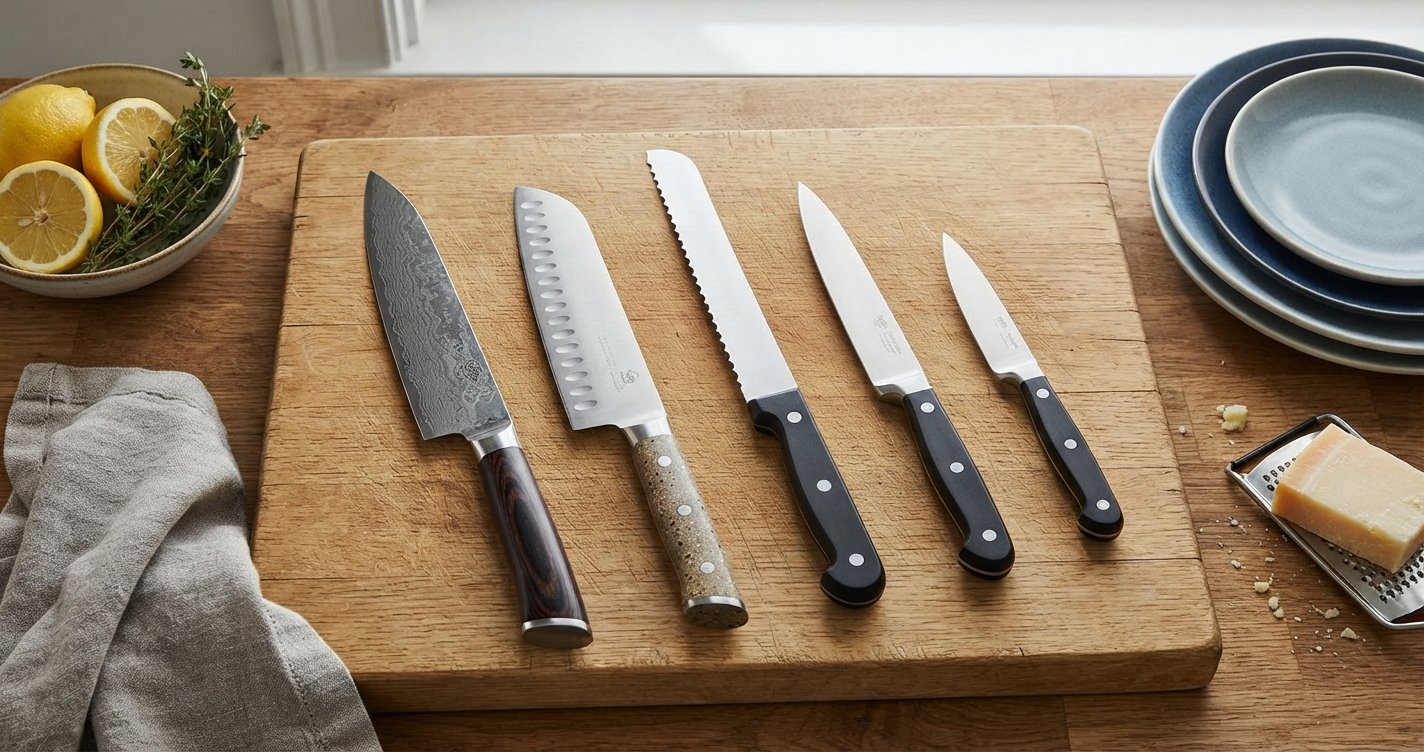
To choose a kitchen knife, start with one good 8-inch chef’s knife that feels comfortable and balanced in your hand, then add a paring knife and a serrated bread knife if you need them. Look for a full tang (steel running through the handle), a non-slip handle, and a steel that suits how much care you’ll give it: stainless is low-maintenance, carbon takes a finer edge but rusts if neglected. Try the knife in your hand if you can, because fit matters more than brand or price.
Step 1: Decide Which Knives You Actually Need
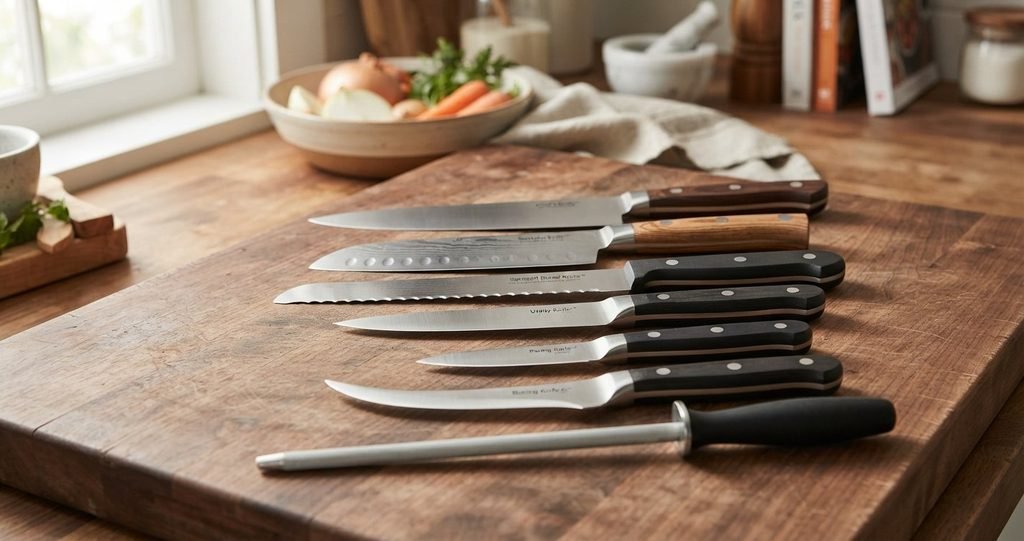
You don’t need a 15-piece block. Misen’s guide to types of kitchen knives says a home cook can start with three knives.
| Knife | Typical size | Best for |
| Chef’s knife | 7 to 10 in (8 in is a common choice) | Chopping, slicing, dicing, mincing; most tasks |
| Paring knife | 3 to 4 in | Peeling, coring, trimming, garnishes |
| Serrated bread knife | 8 to 10 in for loaves | Crusty bread, tomatoes, cakes |
| Utility knife (optional) | 4.5 to 5 in | Medium jobs like tomatoes, cheese, chicken breasts |
| Santoku or nakiri (optional) | Santoku 165 to 180 mm | Vegetable-heavy prep |
| Boning or fillet knife (optional) | Varies | Whole chickens, fish |
What this means: buy a great chef’s knife first. Add specialty knives only when your cooking calls for them.
Step 2: Choose the Blade Steel
Food Republic’s guide summarises the main trade-off:
| Steel | Pros | Cons |
| Stainless steel | Resists rust, dishwasher-safe per that guide (though hand washing is still better) | Can’t be sharpened to as fine an edge |
| Carbon steel | Tougher, takes a sharper edge | Rusts unless cleaned and dried right away; keep it out of the dishwasher |
Hardness matters too. CHOICE’s buying guide notes that manufacturers quoted Rockwell hardness ratings of about 55 to 58, and explains that harder blades keep their edge longer but are more prone to chipping, while softer blades are more durable but need sharpening more often.
Which should you pick? If you want a knife you can wipe and forget, choose stainless. If you enjoy caring for your tools and want a keener edge, carbon steel is an option.
Step 3: Forged or Stamped?
| Forged | Stamped | |
| How it’s made | Shaped from a single piece of steel | Cut from a sheet of steel |
| Weight | Usually heavier | Usually lighter |
| Construction | Often full tang with a bolster | Typically no true bolster |
| Price | Usually higher | Usually lower |
Made In, which sells forged knives, argues forged knives are better balanced and hold an edge longer. That is the view of a brand with something to sell. In contrast, CHOICE’s testing didn’t show forged knives to be consistently better, and its advice is to choose based on how the knife feels to you.
What this means: don’t pay extra for “forged” on the label alone. A well-made stamped knife can be a good, lighter, cheaper choice.
Step 4: Check Handle, Tang, and Balance
- Handle comfort: Food Republic says you want a relaxed, comfortable grip, and to avoid handles that feel bulky or cause numbness.
- Full tang: the steel runs through the handle. Both CHOICE and Food Republic recommend it for strength and balance.
- Balance: Food Republic says the balance point should sit where the blade meets the handle, which reduces hand and wrist fatigue. CHOICE says a well-balanced knife lets the blade roll smoothly to the tip when you cut.
- Bolster: the thick junction between blade and handle adds weight and can protect your fingers if your hand slips forward.
- Safety check: CHOICE advises making sure the knife doesn’t sit on its back with the blade exposed.
- Left- or right-handed: CHOICE notes comfort depends on this, so try before you buy.
Step 5: Pick the Right Size and Weight
Blades range from about 6 to 14 inches, according to Food Republic, and culinary schools commonly use 8 inches. An 8-inch chef’s knife suits most home cooks. If you have smaller hands or a small work surface, a shorter blade may feel safer.
Weight is personal. Food Republic says lighter knives are more maneuverable but struggle with hard ingredients such as winter squash, while heavier knives power through them.
Step 6: Set a Realistic Budget
CHOICE’s review found that knives with a recommended retail price of $100 or more (Australian dollars) mostly outperformed cheaper ones, but performance varied within that group, and a $400 knife isn’t necessarily better than a $200 one. Many cheaper knives still cut well and may be better value. Knives are also often discounted well below the recommended price, so it can pay to wait or shop around.
| Budget approach | When it makes sense |
| Buy one good chef’s knife | Most home cooks |
| Buy a set | If you want several knives at once; CHOICE says a set can be cheaper and more convenient than buying separately |
| Spend more on one premium knife | If you cook daily and care about edge retention |
These are general guidelines, and prices differ by country, brand, and retailer, so compare current prices before you buy.
Step 7: Try It Before You Buy
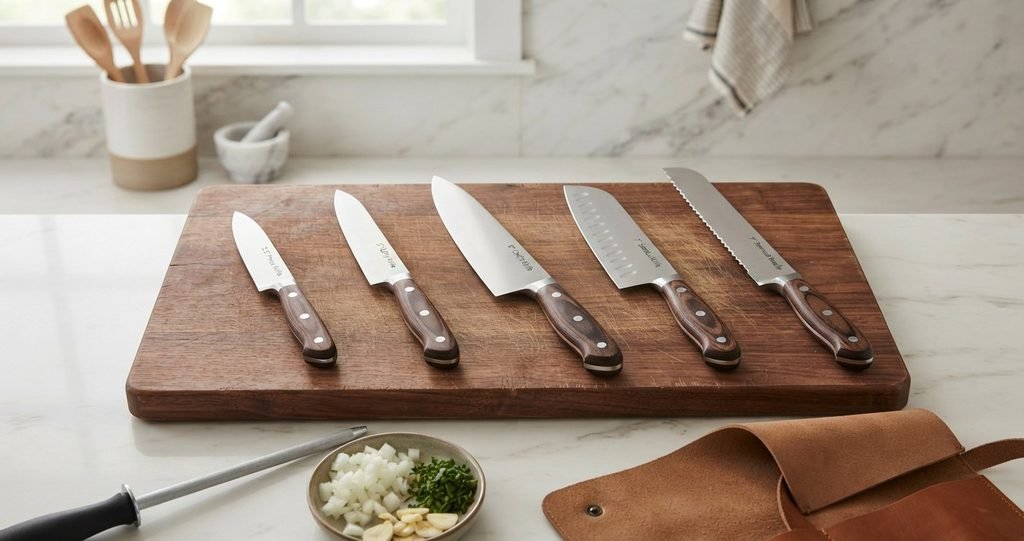
Food Republic suggests holding the knife in a store, pretending to chop a carrot, and checking how it feels, how comfortable it is, and how it balances. If you’re struggling with it, try another. If you’re buying online, check the return policy, and compare the handle shape and weight with a knife you already like.
A Quick Buying Checklist
- Do I need a single chef’s knife or a set?
- Is the blade length comfortable (around 8 inches for most people)?
- Stainless or carbon steel, based on how much care I’ll give it?
- Is it full tang?
- Does it feel balanced and comfortable in my hand?
- Is the handle non-slip?
- Is it within my budget, and have I compared prices?
- Do I know how to care for it?
How to Care for Your Knife
CHOICE’s care advice:
- Use a chopping board softer than the knife, such as wood or plastic.
- Sharpen regularly. Stone sharpening is best, with honing steels or pull-through sharpeners in between, and professional sharpening eventually.
- Wipe off acidic food promptly, since it can permanently stain the blade.
- Wash by hand. Some knives labelled dishwasher-safe still recommend hand washing.
- Store knives in a block, or use a blade guard in a drawer.
Frequently Asked Questions
How do I choose a kitchen knife?
Start with a comfortable, balanced 8-inch chef’s knife with a full tang. Add a paring knife and a serrated bread knife if you need them.
What is the best kitchen knife for a beginner?
A chef’s knife. Misen’s guide recommends starting with a chef’s knife, a paring knife, and a serrated bread knife.
What size chef’s knife should I buy?
Eight inches is a common choice and is widely used in culinary schools. Pick what feels comfortable and controlled.
Is stainless steel or carbon steel better?
Stainless steel resists rust and is lower maintenance. Carbon steel is tougher and takes a finer edge but needs to be cleaned and dried right away.
Are forged knives better than stamped?
Not always. Forged knives are often heavier and better balanced, but CHOICE’s testing didn’t show them to be consistently better. Choose based on feel.
What is a full tang?
It means the steel of the blade runs through the handle. It’s recommended for strength and balance.
How much should I spend on a kitchen knife?
It varies. CHOICE found knives at $100 or more (Australian dollars) mostly outperformed cheaper ones, but price alone didn’t guarantee quality.
Should I buy a knife set or single knives?
A set can be cheaper and more convenient, according to CHOICE. If you only use a few knives, buying a good chef’s knife and a couple of others may be better value.
Can I put kitchen knives in the dishwasher?
It’s best to wash them by hand. CHOICE notes that some knives labelled dishwasher-safe still recommend hand washing.
How often should I sharpen a kitchen knife?
Regularly. Use honing between sharpenings, and have knives professionally sharpened when needed. How often depends on use and steel hardness.
Conclusion
Choosing a kitchen knife comes down to a short list: pick the knife you’ll use most, usually an 8-inch chef’s knife, then check the steel, the full tang, the balance, and how the handle feels in your hand. Don’t pay for features you don’t need, since forged construction and a high price don’t always mean better performance. Decide on your budget, compare current prices, and test the knife if you can. With a few minutes of care after each use, one good knife will serve you for years.
1 thought on “How to Choose a Kitchen Knife: A Simple Buying Guide”