
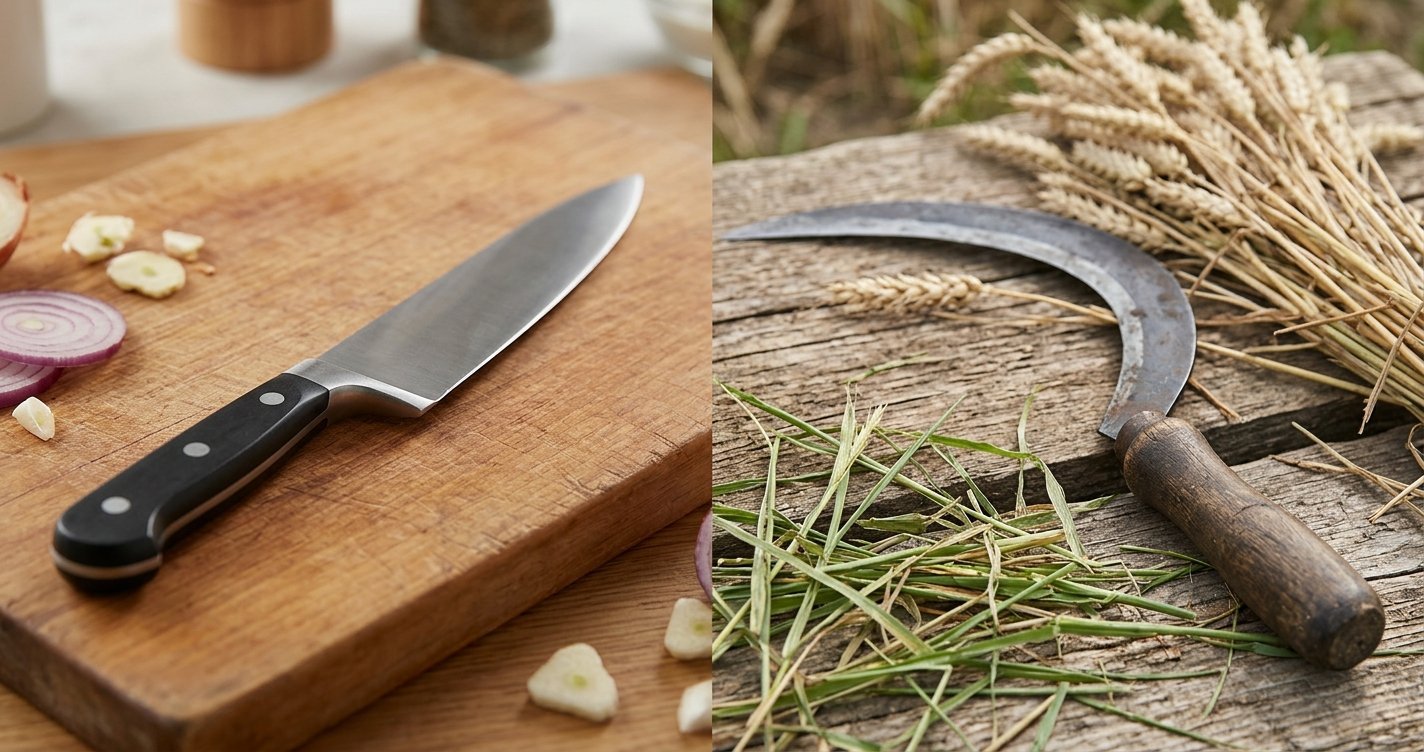
A kitchen knife and a sickle are both cutting tools, but they are designed for very different tasks. A kitchen knife is primarily used for preparing food, including slicing vegetables, cutting meat, chopping herbs, and peeling ingredients. A sickle is a traditional agricultural tool used mainly for cutting grass, weeds, and cereal crops during harvesting.
The main difference between a kitchen knife and a sickle is their blade shape, intended purpose, and cutting technique. A kitchen knife typically has a straight or slightly curved blade, while a sickle features a distinctive curved blade designed to cut vegetation efficiently.
Understanding these differences helps you choose the right tool for cooking, gardening, or agricultural work.
Read More: Zwilling vs Victorinox Knives: Differences, Reviews & Best Choice
What Is a Kitchen Knife?
A kitchen knife is a handheld cutting tool designed for food preparation. It usually consists of a handle and a sharp metal blade, with different blade shapes available for specific culinary tasks.
Common Uses of a Kitchen Knife
- Chopping vegetables: Cutting onions, carrots, potatoes, and other ingredients.
- Slicing meat: Preparing boneless meat, poultry, and fish, depending on the knife type.
- Cutting fruits: Slicing apples, melons, and other produce.
- Mincing herbs: Finely chopping herbs, garlic, and similar ingredients.
- Peeling and trimming: Removing unwanted skin, stems, and small portions of food.
Advantages of a Kitchen Knife
- Offers precision and control for food preparation.
- Comes in specialized designs for different culinary tasks.
- Is generally easy to store in a kitchen drawer or knife block.
- Works effectively on a cutting board when used correctly.
Disadvantages of a Kitchen Knife
- Is not designed for efficiently harvesting large quantities of crops.
- Can become dull with frequent use and requires appropriate maintenance.
- May be unsuitable for cutting thick vegetation or woody plant material.
What Is a Sickle?
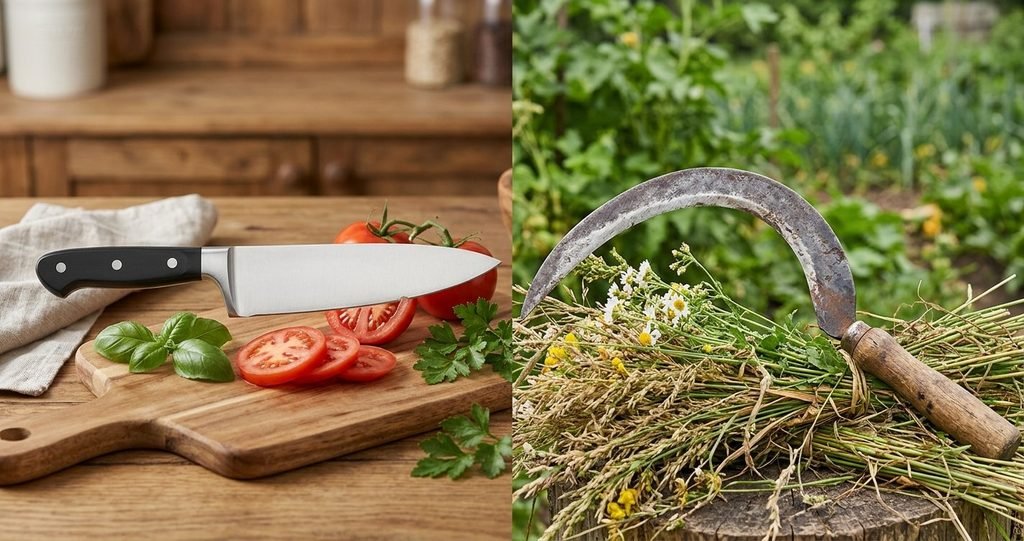
A sickle is a traditional agricultural hand tool with a short handle and a curved blade. It has been used for centuries to harvest crops and cut vegetation in gardens, fields, and rural environments.
Its curved design helps users gather and cut plant stems with a controlled sweeping motion. Depending on the model, the blade may have a smooth or serrated cutting edge.
Common Uses of a Sickle
- Harvesting crops: Cutting mature grain stalks and other agricultural plants.
- Cutting grass: Trimming grass in small areas where powered equipment may be impractical.
- Removing weeds: Clearing certain weeds and unwanted vegetation.
- Garden maintenance: Managing overgrown plants and vegetation in suitable areas.
Advantages of a Sickle
- Is designed for cutting vegetation efficiently.
- Can be useful in small fields, gardens, and areas inaccessible to larger machinery.
- Does not require fuel or electricity.
- Is relatively portable and can be maintained with basic tool-care practices.
Disadvantages of a Sickle
- Is less suitable for precise food preparation.
- Requires practice to use efficiently and safely.
- Can be physically demanding during extended harvesting sessions.
- Needs careful handling, storage, and blade maintenance.
Kitchen Knife vs Sickle: Key Differences
The following table summarizes the main differences between these two cutting tools.
| Feature | Kitchen Knife | Sickle |
| Primary purpose | Food preparation | Harvesting and vegetation cutting |
| Blade shape | Usually straight or slightly curved | Distinctively curved |
| Typical cutting target | Food ingredients | Grass, weeds, and crop stalks |
| Cutting technique | Slicing, chopping, and rocking | Sweeping or drawing through vegetation |
| Precision | High for culinary tasks | Best suited to agricultural cutting |
| Typical environment | Kitchen | Farm, garden, or field |
| Common materials | Stainless steel and other blade steels | Carbon steel, stainless steel, or other suitable metals |
| Maintenance | Cleaning, drying, and sharpening | Cleaning, drying, sharpening, and checking the handle |
| Best application | Preparing meals | Cutting and harvesting plants |
Actual performance depends on the blade design, sharpness, materials, and the task being performed.
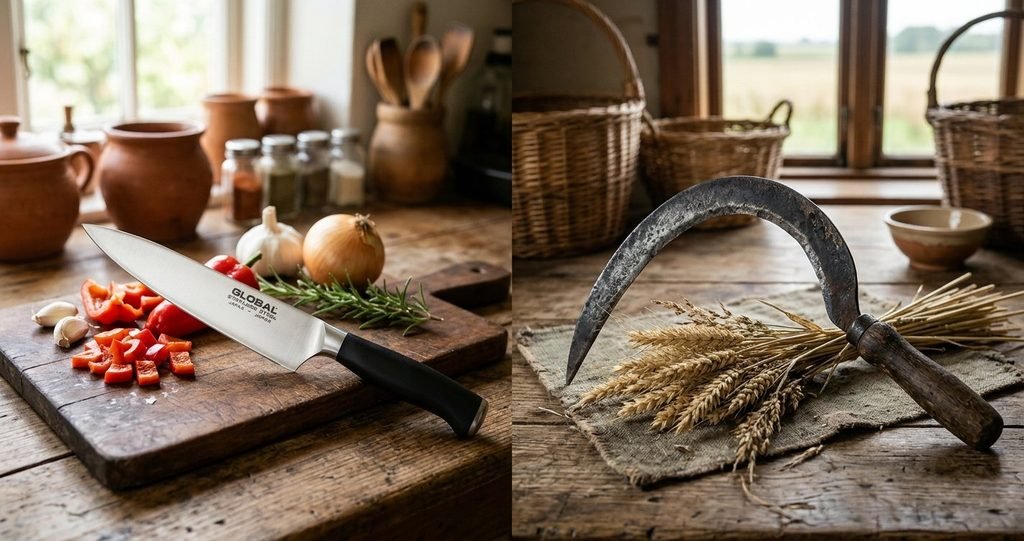
Kitchen Knife vs Sickle: Which One Cuts Better?
Neither tool is universally better at cutting. Their performance depends on the material and the intended application.
For Food Preparation
A kitchen knife is the better choice for cutting vegetables, fruits, meat, and other food ingredients. Its blade geometry and handle design support controlled, precise movements on a cutting board.
A sickle is not intended for detailed culinary work and would generally be impractical for slicing ingredients accurately.
For Harvesting Crops
A sickle is generally more suitable for cutting grass, grain stalks, and other vegetation. Its curved blade is designed to engage plant stems during a sweeping motion.
A kitchen knife can cut some plant stems, but it is usually less efficient for harvesting large numbers of stalks.
For Gardening
The best choice depends on the job. A kitchen knife may help with small, precise tasks involving harvested produce, while a sickle is more appropriate for cutting grass and suitable vegetation.
For thick woody branches, however, neither tool may be ideal; pruning shears, loppers, or a pruning saw may be more appropriate.
Kitchen Knife vs Sickle: Blade Design Explained
Blade design is one of the most important differences between a kitchen knife and a sickle.
Kitchen Knife Blade Design
Kitchen knife blades are designed around specific food-preparation tasks. A chef’s knife typically has a broad blade for chopping and slicing, while a paring knife has a smaller blade for detailed work.
The blade’s edge geometry, thickness, and length influence cutting precision and performance.
Sickle Blade Design
A sickle features a curved blade that helps engage plant stems and cut vegetation through a drawing or sweeping motion. Some designs use serrations to improve their grip on fibrous plant material.
The curvature, blade length, and edge style affect the tool’s suitability for different crops and vegetation.
Kitchen Knife vs Sickle: Materials and Durability
Both tools can be made from different types of steel, but durability depends on more than the material alone.
Kitchen knives commonly use stainless steel, carbon steel, or specialized blade alloys. Stainless steel generally offers better corrosion resistance, while some carbon-steel blades are valued for their sharpening characteristics.
Sickles may also use carbon steel or stainless steel, depending on the manufacturer and intended working conditions. Agricultural tools must withstand repeated contact with plant material and may require regular sharpening.
To extend the life of either tool:
- Clean the blade after use.
- Dry it thoroughly before storage.
- Sharpen it using a method appropriate for its blade design.
- Inspect the handle and attachment points for damage.
- Store it securely, away from children and moisture.
Kitchen Knife vs Sickle: Safety Considerations
Both tools have sharp edges and should be handled carefully.
When using a kitchen knife, work on a stable cutting board, keep fingers away from the cutting edge, and use a suitable knife for the ingredient.
When using a sickle, maintain a stable stance, keep other people clear of the cutting area, and use controlled movements away from your body. Wear appropriate footwear and protective equipment when working in fields or overgrown areas.
Never leave either tool exposed where someone could accidentally contact its blade. Clean and store each tool safely after use.
Can You Use a Kitchen Knife Instead of a Sickle?
A kitchen knife can cut some grass or plant stems, but it is not a practical replacement for a sickle when harvesting crops or clearing vegetation over a larger area.
The narrow blade and culinary handle design of a kitchen knife are optimized for food preparation rather than repeated agricultural cutting. A sickle provides a blade shape and cutting motion better suited to gathering and cutting plant stems.
Similarly, a sickle should not replace a kitchen knife for routine food preparation because its design does not provide the same precision and convenience.
Choosing the correct tool improves efficiency and reduces the likelihood of accidental injury.
Kitchen Knife vs Sickle: Which Tool Should You Choose?
The right tool depends on what you need to accomplish.
- Choose a kitchen knife if you need to chop vegetables, slice meat, prepare fruit, or perform other food-preparation tasks.
- Choose a sickle if you need to harvest crops, cut grass, or manage suitable vegetation by hand.
- Choose a gardening tool if you need to prune woody plants or cut thick branches.
For most households, a kitchen knife is an essential cooking tool, while a sickle is useful primarily for agricultural and gardening work.
Frequently Asked Questions
1. What is the main difference between a kitchen knife and a sickle?
A kitchen knife is designed for preparing food, whereas a sickle is designed for cutting grass, weeds, and crop stalks. Their blade shapes reflect these different purposes.
2. Is a sickle sharper than a kitchen knife?
Not necessarily. Sharpness depends on the blade’s edge, condition, and maintenance. Both tools can have sharp cutting edges, but they are optimized for different materials and cutting techniques.
3. Can a sickle be used to cut vegetables?
Although a sickle may physically cut some vegetables, it is not designed for precise food preparation. A clean, properly maintained kitchen knife is the more practical and hygienic option.
4. Why does a sickle have a curved blade?
The curved blade helps engage plant stems and makes sweeping or drawing cuts effective when harvesting vegetation.
5. Which tool is better for farming?
A sickle is generally better for small-scale manual harvesting and cutting vegetation. The most appropriate tool depends on the crop, field conditions, and scale of the work.
6. Which tool is easier to maintain?
Both tools require cleaning, drying, inspection, and occasional sharpening. A kitchen knife may need more frequent cleaning during food preparation, while a sickle may need additional attention after contact with soil, sap, or vegetation.
7. Can a kitchen knife replace a sickle for harvesting?
A kitchen knife can cut individual plant stems, but a sickle is usually more efficient and better suited to repeated harvesting. For larger fields, powered harvesting equipment may be more practical.
Conclusion
The comparison between a kitchen knife and a sickle shows that both tools serve important but distinct purposes. A kitchen knife is best for precise food preparation, while a sickle is designed for cutting vegetation and harvesting crops.
Their blade shapes, cutting techniques, and intended working environments determine their effectiveness. Instead of asking which tool is better overall, consider which tool is best for the task at hand.
In summary: Choose a kitchen knife for cooking and a sickle for agricultural cutting. Using the right tool improves efficiency, convenience, and safety.
1 thought on “Kitchen Knife vs Sickle: Differences, Uses & Comparison”